DTC fulfillment is critical for Shopify merchants in 2026. Here's why:
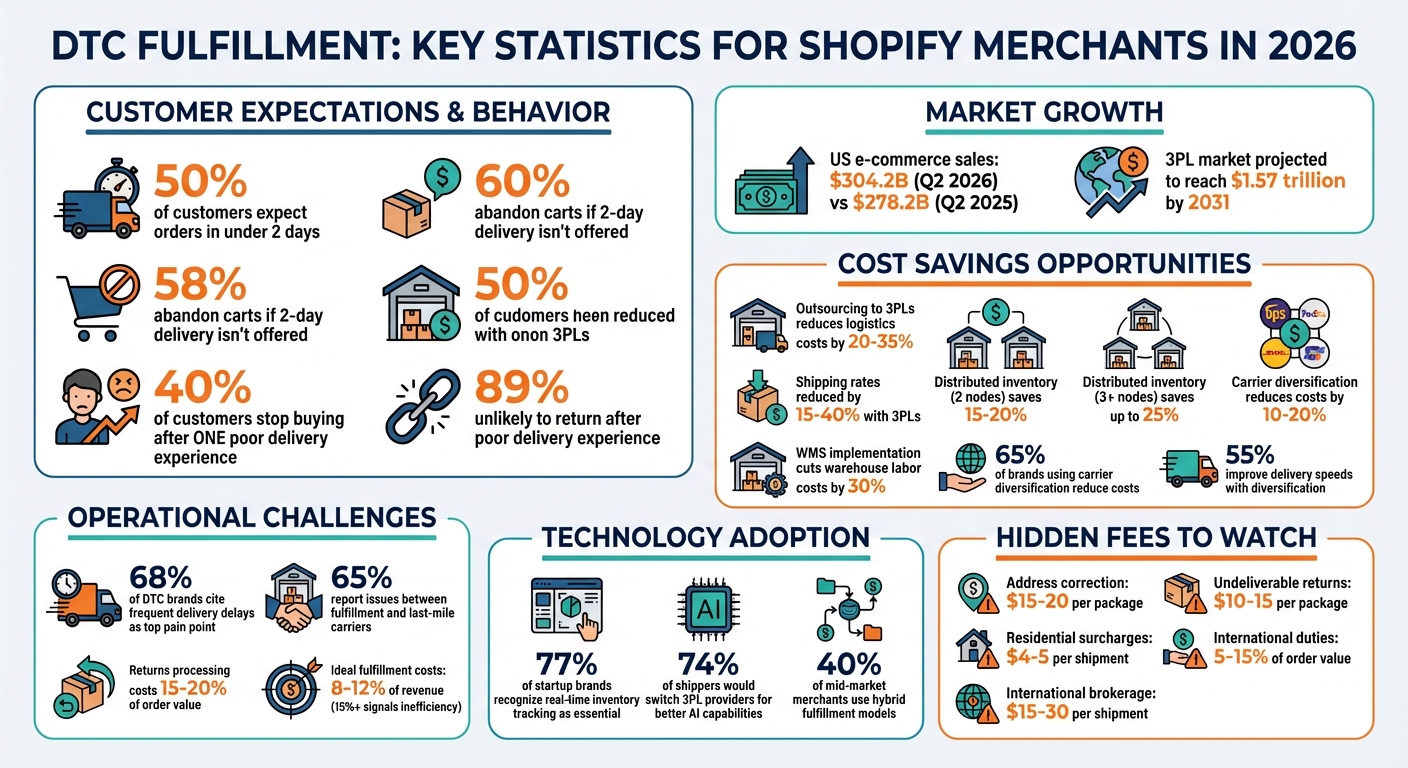
- Fast delivery is non-negotiable. Half of customers expect orders in under two days, and 58% abandon carts if this isn't offered.
- Shopify no longer handles fulfillment. Since shutting down its Fulfillment Network (SFN) in 2023, merchants must manage logistics themselves or partner with 3PLs.
- 3PLs can save costs. Outsourcing can reduce logistics expenses by 20–35% and shipping rates by 15–40%.
- Fulfillment impacts loyalty. 40% of customers stop buying from brands after one poor delivery experience.
To stay competitive, merchants need to streamline operations, leverage tools like WMS and OMS, and consider distributed inventory networks. This guide covers trends, challenges, and solutions for scaling your Shopify DTC brand efficiently.
DTC Fulfillment Statistics and Cost Savings for Shopify Merchants 2026
Top Fulfillment Methods Easily Fulfill Orders for Shopify for Beginners

sbb-itb-eb0f906
Why DTC Fulfillment Matters for E-commerce
Fulfillment isn’t just about logistics - it’s the moment your brand delivers on its promise. When someone clicks "buy", they’re trusting you to get their order right and on time. Messing up here - whether it’s a delay or a packaging mistake - can seriously damage that trust. In fact, US e-commerce sales hit $304.2 billion in Q2 of 2026, up from $278.2 billion the year before. With competition growing, meeting customer expectations isn’t optional.
The "Amazon Effect" has set the bar high. Two-day delivery isn’t a luxury anymore - it’s expected. Half of all customers now expect their orders to arrive in under two days. For Shopify merchants, this means fulfillment isn’t just a background task; it’s a key factor in staying competitive. Your ability to deliver quickly and accurately often determines whether customers stick with you or head to a competitor. And this connection between fulfillment and trust underscores how critical it is for retention and keeping costs manageable.
It’s not just about the first sale, either. Almost 40% of customers stop buying from brands after a fulfillment failure. A late delivery or damaged package can undo all the effort you’ve put into marketing. On the flip side, when orders arrive on time and in perfect condition, customers are much more likely to come back. This is why the 3PL market is projected to reach $1.57 trillion by 2031. Outsourcing fulfillment to experts can cut logistics costs by 20% to 35% while improving service quality.
How Fulfillment Affects Customer Retention
As customer expectations rise, every detail of fulfillment becomes critical for loyalty. Fast, reliable delivery is the foundation of repeat business. Take NZXT, for example. In 2025, they cut their fulfillment times from 10 days to under two by integrating e-commerce data for faster order processing. This wasn’t just about speed - it transformed the customer experience and strengthened loyalty.
On the flip side, poor fulfillment can be a financial drain. Returns processing alone can eat up 15-20% of an order’s value. Add to that the hidden cost of losing customers who don’t give second chances after a bad experience. Brands like Parachute have tackled this by investing in omnichannel fulfillment. By using Shopify’s ship-from-store network, they turned retail locations into micro-fulfillment centers, processing 1,300 click-and-collect orders - 35% of their annual BOPIS volume. As Meg Marsh, Parachute’s SVP of Operations, put it:
"Being able to leverage Shopify's buy online, pick up in-store feature actually allows us to tell our online customers that we even have stores."
This strategy didn’t just cut shipping costs - it created a seamless experience that kept customers coming back.
Common Fulfillment Challenges for Shopify Merchants
Even with advanced tools, Shopify merchants face tough challenges in fulfillment. While Shopify simplifies tasks like shipping labels and order tracking, it doesn’t handle the physical logistics. And since Shopify shut down its Fulfillment Network (SFN) in 2023, merchants have had to either manage their own warehousing or partner with 3PLs - each option with its own set of trade-offs.
One major issue is multi-channel order management. Managing separate systems for Shopify, Amazon, and retail often creates "inventory islands", leading to overselling and missed service-level agreements (SLAs). A unified, real-time inventory system is crucial to avoid these pitfalls.
Another challenge is inventory tracking errors, which can spiral out of control as businesses scale. Solutions like warehouse management systems (WMS) can cut labor costs by 30% and reduce order errors to under 1% with tools like barcode scanning.
Merchants also struggle with lack of transparency from 3PLs. 68% of DTC brands cite frequent delivery delays as their top operational pain point, and 65% report that issues between fulfillment and last-mile carriers hurt customer experience. When a 3PL misses an SLA, it’s your brand that takes the hit. Tools like 3PLs Enable Real Time Tracking Dtc Brands can help maintain visibility and accountability.
| Scale Signal | Action Required |
|---|---|
| Shipping errors above 1% | Implement WMS and barcode scanning |
| 2-day delivery coverage below 60% | Add a second fulfillment node/warehouse |
| Carrier costs 20%+ above benchmark | Renegotiate rates or switch to a 3PL |
| Peak volume 3x+ off-peak | Secure 3PL overflow contract 6 months ahead |
DTC Fulfillment Trends in 2026
To tackle these challenges, new fulfillment trends are reshaping the game. AI-powered demand forecasting is becoming standard for mid-market brands. Instead of guessing or relying on outdated data, predictive analytics helps merchants optimize inventory and prepare for seasonal spikes - like the Q4 surge that often triples order volumes. This reduces both stockouts and excess inventory.
Environmentally conscious logistics is no longer optional. Brands like Allbirds have reimagined packaging, using shoeboxes that double as mailers to cut waste and lower shipping costs. Patagonia’s Worn Wear program turns returns into resale opportunities, making reverse logistics a selling point. Younger shoppers, in particular, expect brands to minimize their environmental impact, and fulfillment is a visible part of that effort.
Distributed inventory networks are replacing the single-warehouse model. By placing top-selling SKUs in multiple regional centers, brands can offer two-day delivery without relying on costly air shipping. 65% of brands using carrier diversification reduce costs, and 55% improve delivery speeds. The trick is balancing inventory distribution to avoid creating idle stock in the wrong places.
Finally, hybrid fulfillment models are on the rise. 40% of mid-market merchants now blend in-house and 3PL fulfillment. This allows them to keep high-touch or custom orders in-house while outsourcing standard items to 3PLs. It’s a smart way to maintain control where it matters while leveraging 3PL efficiency for routine tasks. For more tips on structuring these partnerships, check out our guide: Top 10 3Pl Providers For Dtc Brands In 2025.
Automated Fulfillment Onboarding Platforms for DTC Brands
Automated onboarding platforms are transforming how DTC brands integrate with 3PL providers, making the process faster and far less prone to errors. In the past, onboarding a new 3PL often meant weeks of tedious back-and-forth emails, manual CSV uploads, and constant accuracy checks. Today, platforms leveraging Shopify's Fulfillment Service API simplify this process by registering as a fulfillment location. This allows orders to route automatically while tracking data syncs back to your store in real time. The result? No more manual data entry or delays - your WMS, OMS, and sales channels stay perfectly aligned.
One major improvement is the shift from daily batch uploads to continuous synchronization. This provides real-time inventory updates, which help prevent overselling across multiple channels - whether you're selling on Shopify, Amazon, or even in physical stores. It eliminates "inventory islands", where stock levels don't match up. These platforms also optimize order routing, using zone-based and cost-saving rules to cut down on split shipments. This level of automation supports the two-day delivery expectations of modern shoppers, 58% of whom will abandon a purchase if an item isn’t available.
AI-Powered Inventory Forecasting
AI tools are stepping up inventory management by going beyond simple reorder alerts. Take Fabrikatör, for example. This platform uses historical sales data, growth trends, and seasonality directly from Shopify to suggest purchase orders and restocking schedules automatically. This approach helps brands avoid both stockouts and excess inventory piling up in the wrong locations.
A key part of this strategy is distributed inventory management. By placing top-selling SKUs in multiple warehouses - like on the East Coast, West Coast, and in central locations - brands can offer two-day delivery via ground shipping, avoiding costly air freight.
The numbers speak for themselves: 77% of startup brands now recognize real-time inventory tracking and last-mile cost analytics as essential technologies. AI-powered tools don’t just tell you what to reorder; they also pinpoint where inventory should go. For instance, if a heatmap shows high order volumes in the Southeast, the system might recommend moving more stock to an Atlanta warehouse. This kind of precision can cut shipping costs by 15–25% for brands using multi-node networks, while also improving fulfillment speed and profitability.
SLA Monitoring and Real-Time Alerts
Keeping track of service level agreements (SLAs) is critical for ensuring operational efficiency. Modern platforms monitor key timestamps - like when an order is placed, picked, and shipped - and compare them to your SLA targets. For example, industry standards for 3PLs require a 99%+ same-day fulfillment rate for orders received before 2:00 PM local time. If a provider misses the deadline, automated alerts notify you immediately, often through Shopify Flow.
Tech-forward 3PLs like Atomix and SHIPHYPE offer real-time dashboards that track metrics such as order accuracy and receiving timelines. These tools even identify root causes of delays, whether it’s a carrier issue, warehouse staffing problem, or system error. With 68% of DTC brands citing frequent delivery delays as a top challenge, this level of visibility is invaluable. Automated alerts ensure quick responses to issues like low inventory or missed carrier pickups, helping brands maintain tighter control over operations. Advanced tools like Forthmatch add another layer of accountability by providing data-driven insights into 3PL performance.
Forthmatch: Shopify App for 3PL Performance Tracking
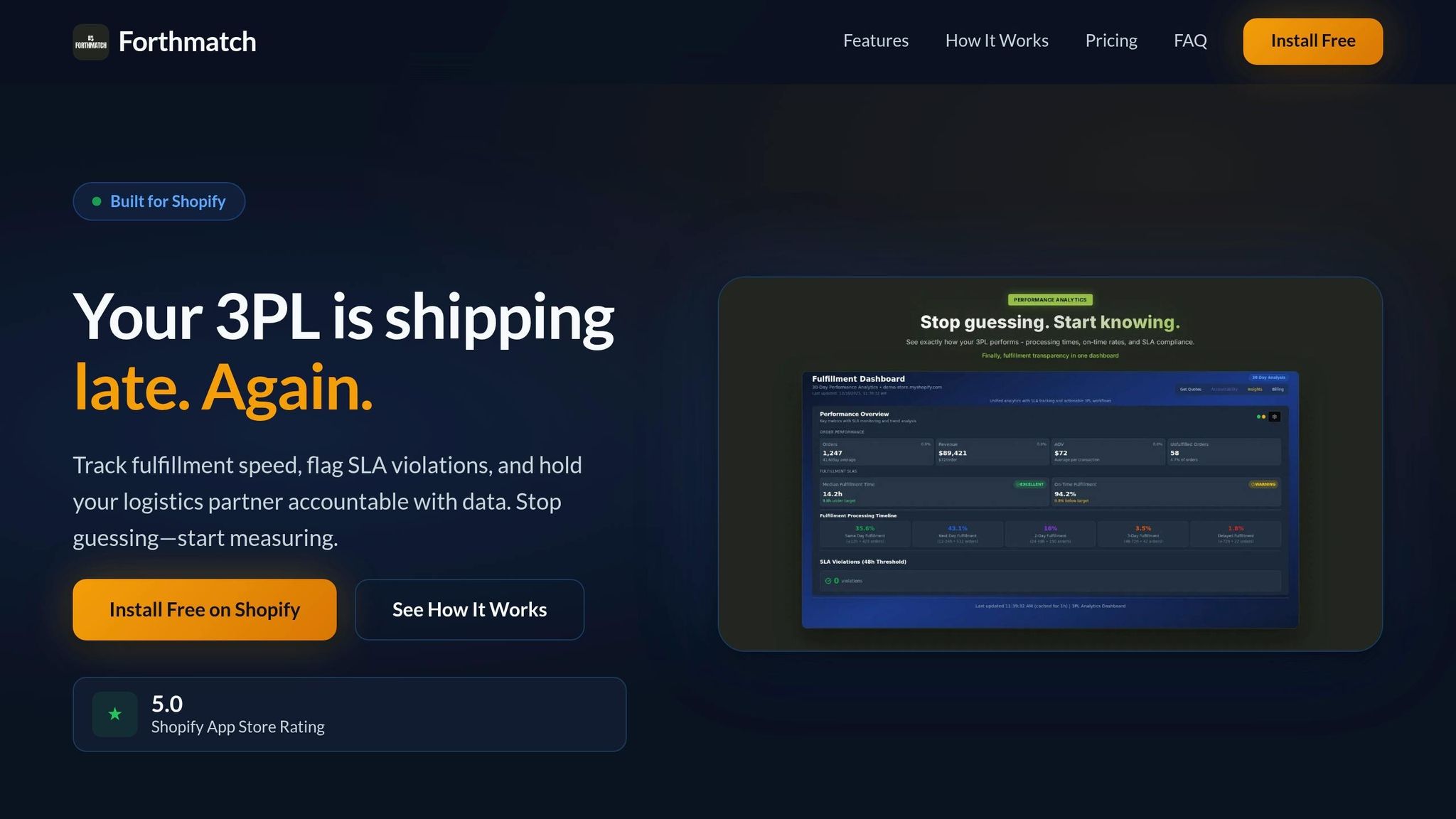
Forthmatch is a Shopify app designed to hold your 3PL accountable. Once installed, it analyzes up to 90 days of order history, measuring the time between "Order Created" and "Fulfillment" timestamps. You set your SLA targets - like shipping within 24 hours - and the app flags any missed benchmarks. This turns vague concerns like "shipping seems slow" into actionable data, such as "15% of orders missed the 24-hour SLA last month."
But it doesn’t stop at monitoring. Forthmatch tracks whether alerts sent to your 3PL’s account manager are acknowledged, creating a paper trail of their responsiveness. For quarterly reviews or contract negotiations, the app offers an Accountability Session ($89 per session), which tracks performance over a focused 2–4 week period. At the end, you get a PDF report comparing before-and-after stats, making it easy to highlight ongoing issues. If your 3PL doesn’t improve, the RFP Quote Request feature ($44 per request) generates an automated Request for Proposal using your real order data, connecting you with vetted regional providers.
Starting at $19/month with a 14-day trial, Forthmatch equips brands with customizable SLA tracking, automated alerts, and detailed quarterly reports. Considering that 74% of shippers would switch 3PL providers for better AI capabilities, this app gives you the tools to make informed decisions and demand better performance from your partners.
Best DTC Fulfillment Tools & Software
Top Fulfillment Optimization Tools
When it comes to managing DTC fulfillment, having the right tools in place can make all the difference. These tools not only streamline operations but also help improve customer satisfaction. For merchants just starting out, Shopify Shipping is a great option. It's built directly into the Shopify dashboard, offering discounts of 40–80% on USPS, UPS, and DHL rates without any monthly fees. This solution works best for businesses shipping fewer than 50 orders per day and handling fulfillment internally.
However, as your business grows and you start managing higher order volumes or multiple warehouses, more advanced tools become necessary. Nventory, an Order Management System (OMS), uses zone-based and cost-optimized routing to minimize split shipments and shorten delivery times. For warehouse operations, SkuVault is a powerful Warehouse Management System (WMS) offering features like bin location management, barcode scanning, and pick lists. Implementing a tool like SkuVault can cut warehouse labor costs by roughly 30%.
On the inventory side, tools like Inventory Planner and Cin7 use AI to analyze past sales and seasonal trends, helping you forecast demand and set restocking schedules. This approach can reduce stockouts by 40% and overstock by 35%. Meanwhile, ByteStand bridges Shopify with Amazon’s Multi-Channel Fulfillment, and Shopify Flow automates tasks like order routing and inventory syncing.
For tracking performance, Forthmatch provides actionable insights into your 3PL operations. It offers SLA tracking and performance reviews, turning vague concerns into measurable data. For example, it can reveal that 15% of orders missed a 24-hour SLA, which is critical since 89% of customers are unlikely to return after a poor delivery experience. Priced at $19 per month with a 14-day trial, it ensures your decisions are guided by data, not guesswork.
Feature and Pricing Comparison
Here’s a breakdown of the key features and pricing for some of the top fulfillment tools:
| Tool | Core Function | Key Features | Pricing |
|---|---|---|---|
| Shopify Shipping | Native Labeling | 40–80% discounted rates; built-in tracking; USPS, UPS, DHL support | Included with Shopify plan |
| Nventory | Order Management (OMS) | Zone-based routing; cost optimization; multi-channel sync | Subscription-based |
| SkuVault | Warehouse Management (WMS) | Bin locations; barcode scanning; pick lists | $499–$999/month |
| Inventory Planner | AI Forecasting | Demand modeling; reduces stockouts by 40% | Subscription-based |
| Shopify Flow | Automation | Order routing; inventory sync; exception alerts | Included with Shopify Plus |
| ByteStand | Amazon MCF Integration | Connects Shopify to Amazon FBA; unbranded packaging | Subscription-based |
| Forthmatch | 3PL Performance Tracking | SLA monitoring; delay root cause analysis; RFP generation | $19/month; 14-day trial |
For merchants handling more than 200 orders daily or spending over 15% of revenue on shipping, upgrading to a robust OMS and WMS is a smart move. To dive deeper into DTC fulfillment strategies, check out resources like the Ultimate Guide to DTC Logistics Tech Scalability, 3PLs Enable Real-Time Tracking for DTC Brands, and Top 10 3PL Providers for DTC Brands in 2025.
E-Commerce Logistics Cost Management for DTC Brands
Cost-Tracking Software for Shopify Merchants
Managing fulfillment costs is essential for keeping DTC brands profitable. Ideally, fulfillment expenses should stay within 8–12% of revenue, as crossing the 15% threshold often signals inefficiencies. For Shopify merchants, knowing exactly where your money is going - whether it’s pick-and-pack fees or unexpected carrier surcharges - is the first step in taking control of these costs.
Tools like Forthmatch’s Accountability Sessions can help you measure your fulfillment ROI over a targeted 2–4 week period. For $89, you’ll receive a detailed PDF report that benchmarks your performance, offering insights that can strengthen your negotiating position with 3PL providers. This is especially useful during quarterly reviews or when renegotiating contracts. The analysis doesn’t just show how much you’re spending but explains why - highlighting issues like missed SLAs, inefficient routing, or delays tied to specific carriers. For ongoing insights, their Performance Insights plan, priced at $19 per month with a 14-day trial, tracks SLA violations and breaks down carrier performance, transforming vague cost concerns into actionable data.
Beyond tracking, it’s critical to regularly review and address hidden fees. For example, address correction fees can range from $15–$20 per package, undeliverable returns cost $10–$15, and residential surcharges add $4–$5 per shipment. These fees can quietly chip away at your margins, reducing profitability by 2–3 percentage points annually. Simple solutions like implementing accurate address validation at checkout and keeping a close eye on return rates can help protect your bottom line.
Once you’ve got a clear picture of your costs, the next step is finding ways to reduce them effectively.
How to Reduce Shipping Costs
Tracking costs is just the beginning - smart strategies for shipping can take your DTC fulfillment to the next level. To manage shipping expenses more efficiently, focus on inventory placement, carrier options, and packaging choices.
One of the most impactful methods is Shopify 3PL integration for inventory management and distributed inventory. By using a multi-node network, you can save 15–20% with two fulfillment sites and up to 25% with three or more. Strategically placing inventory in regional fulfillment centers - such as East Coast, West Coast, and Central US - allows brands to fulfill 95% of US orders using cost-effective ground shipping, significantly reducing expensive long-zone air shipping.
Another effective approach is carrier diversification. Instead of relying solely on major carriers like FedEx or UPS, use rate-shopping software to compare costs across USPS, regional carriers, and specialty providers for each shipment. This strategy can cut shipping costs by 10–20%. In fact, 65% of brands that diversify carriers report noticeable cost reductions. For instance, USPS is ideal for lightweight, non-urgent packages, while regional carriers excel in densely populated urban areas within Zones 1–4.
Packaging optimization is another way to avoid unnecessary expenses. By redesigning packaging to minimize dimensional weight fees, brands like Allbirds have reduced shipping costs by 5–8% annually. Using appropriately sized boxes or switching to poly mailers for non-fragile items can make a big difference. Additionally, setting free shipping thresholds 20–30% above your average order value (AOV) encourages larger purchases while maintaining healthy margins.
For international shipping, consider implementing DDP (Delivered Duty Paid) to calculate duties and taxes upfront during checkout. This eliminates unexpected fees like $15–$30 brokerage charges and 5–15% duties, which often lead to cart abandonment. Canadian brands generating 30–40% of revenue from US customers should consider adding a US-based fulfillment center to streamline cross-border orders and remove customs-related hurdles entirely. Finally, using an Order Management System (OMS) to fulfill orders from a single location can prevent doubling shipping costs on multi-item purchases.
Conclusion: How to Scale Your Shopify DTC Brand with Better Fulfillment
Scaling a Shopify DTC brand in 2026 means treating fulfillment as more than just a backend process - it's a critical part of your growth strategy. As your revenue grows, your fulfillment operations need to evolve with it. For example, in-house fulfillment might work until you hit $1 million–$3 million in revenue, but beyond that, partnering with a professional 3PL that matches your needs becomes essential. Once you reach $8 million–$10 million, distributed inventory across multiple locations becomes crucial. To stay ahead, review your capacity quarterly and plan upgrades to your fulfillment infrastructure 6–12 months in advance. This kind of proactive approach, paired with the right technology, sets the foundation for scaling effectively.
Since Shopify sold its logistics arm to Flexport in 2023, merchants now rely on Shopify as a software layer for key operations like order routing, label creation, and inventory management. To stay competitive, consider adopting an advanced Order Management System (OMS) with features like zone-based routing and reduced split shipments. These tools can cut shipping costs by 15–25% and shrink delivery times from 5–7 days to just 2–3 days - a critical improvement when 58% of shoppers expect 2-day delivery. For more tips on refining your logistics setup, check out our Ultimate Guide To DTC Logistics Tech Scalability.
Technology also plays a vital role in maintaining transparency and accountability. Tools like Forthmatch's Performance Insights plan (starting at $19/month with a 14-day trial) offer real-time monitoring of service-level agreements (SLAs) and carrier performance. This kind of data turns vague concerns into actionable insights. With 68% of DTC brands citing delivery delays as a major issue, having hard data allows you to hold 3PLs accountable - or make the case for switching providers. For a deeper dive, Forthmatch offers Accountability Sessions (priced at $89), which provide detailed PDF reports benchmarking your fulfillment ROI over a 2–4 week period. These reports are perfect for quarterly reviews or renegotiating contracts. Learn more about maintaining visibility in our guide on 3PLs Enable Real-Time Tracking for DTC Brands.
In addition to data-driven insights, diversification adds another layer of resilience to your operations. A balanced carrier mix - 60% primary, 30% secondary, and 10% regional carriers - helps ensure capacity during high-demand periods while keeping rates competitive. In fact, 65% of brands using diversified carriers report notable cost savings. Similarly, distributing inventory across East Coast, West Coast, and Central U.S. locations allows 95% of orders to ship via affordable ground services. For help finding the right partners, check out our Top 10 3PL Providers for DTC Brands in 2025. Building a resilient and diversified system is key to reducing risks and optimizing your fulfillment strategy.
FAQs
Are there logistics services that support both B2B and DTC?
Yes, certain logistics services handle both B2B (business-to-business) and DTC (direct-to-consumer) fulfillment. These systems let brands streamline operations by managing retail and consumer shipping through a single platform. They often come with flexible warehousing options and clear pricing structures, making them easier to integrate into various business models.
best inventory and fulfillment solutions for growing dtc brands 2026?
For DTC brands aiming to expand in 2026, the best inventory and fulfillment strategies prioritize scalability, efficiency, and seamless connections with e-commerce platforms. These systems are built to handle growing order volumes without compromising on delivery speed or customer experience.
Key features include:
- Advanced Warehousing and Inventory Management: Modern tools help brands track stock levels, prevent overstocking or shortages, and streamline operations.
- Shipping Systems: Designed to ensure fast, reliable delivery, these systems are essential for meeting customer expectations in a competitive market.
Additionally, third-party logistics (3PL) providers are becoming indispensable. They offer services like real-time tracking and optimized logistics, giving brands the flexibility they need to grow while maintaining high levels of customer satisfaction.
best inventory and fulfillment solutions for growing dtc brands 2026?
As direct-to-consumer (DTC) brands continue to grow, the top inventory and fulfillment solutions in 2026 are all about scalability, flexibility, and seamless connections with e-commerce platforms. These tools are designed to handle the complexities of modern retail, especially with the rise of omnichannel fulfillment.
Solutions that support omnichannel fulfillment and advanced third-party logistics (3PL) services are becoming essential. They help brands efficiently manage sales, inventory, and shipping across multiple channels, reducing the headaches of juggling orders from different platforms.
Key features like automation, real-time tracking, and integrations with platforms such as Shopify are game-changers. They streamline operations, making it easier for brands to grow while ensuring their customers continue to enjoy a smooth and reliable shopping experience.
best third-party logistics software for e-commerce amazon fba dtc?
When it comes to e-commerce in 2026, the best 3PL (third-party logistics) software options are those that seamlessly handle Shopify integrations, multi-channel orders, inventory tracking, and shipping operations. Platforms like ShipBob stand out with features such as real-time inventory tracking, scalable warehousing solutions, and support for both DTC (direct-to-consumer) and B2B channels.
Another strong contender is Fulfillment Plus, which not only integrates with major shipping carriers but also offers real-time tracking capabilities. These features make it an excellent choice for managing Amazon FBA and DTC workflows efficiently.
best third-party logistics software for e-commerce amazon fba dtc?
When it comes to choosing the right third-party logistics (3PL) software in 2026, the key lies in finding solutions that cater to the diverse needs of e-commerce, Amazon FBA, and direct-to-consumer (DTC) fulfillment. The best options will prioritize multi-channel fulfillment, real-time tracking, and seamless integration with platforms like Shopify and Amazon.
Here’s what to look for:
- Robust API Integrations: Ensure the software can connect effortlessly with your existing systems, making it easier to manage orders, inventory, and customer data across multiple platforms.
- Scalability: Growing DTC brands need logistics solutions that can adapt as their business expands, handling increased order volumes without compromising efficiency.
- Cost Management Tools: Effective cost control is crucial for profitability. Look for software that helps monitor and optimize expenses in warehousing, shipping, and fulfillment.
Efficiency in these areas - warehousing, shipping, and fulfillment - should be at the core of your evaluation process. By focusing on these capabilities, you’ll be better equipped to meet the demands of a competitive e-commerce landscape.