AI is transforming how 3PL providers cut costs and improve logistics. From reducing route costs by 31% to increasing warehouse productivity by 57%, AI tools like route optimization, inventory management, and predictive maintenance are delivering measurable results. Companies using AI report a 15% drop in logistics costs and a 22% boost in efficiency. With 74% of shippers willing to switch to AI-powered 3PLs, adopting these technologies is no longer optional - it’s necessary to stay competitive.
Key areas where AI delivers results:
- Route Optimization: Cuts fuel costs, shortens delivery times, and improves on-time rates.
- Inventory Management: Reduces excess stock by 35% and speeds up order fulfillment.
- Demand Forecasting: Improves accuracy, helping 3PLs plan resources better.
- Warehouse Automation: Uses robotics and AI to boost productivity and reduce errors.
- Predictive Maintenance: Prevents equipment downtime and lowers repair costs.
- SLA Monitoring: Tracks performance in real time to ensure service quality.
These solutions not only save money but also improve delivery performance, customer satisfaction, and scalability. For example, a 3PL saved $4.2M annually by implementing AI-powered route optimization. The numbers show why AI has become essential in logistics.
Leveraging AI & Automation Transforming Logistics & 3PL with Smart Technologies | Supply Chain Talks
sbb-itb-eb0f906
1. Route Optimization
AI-powered route optimization has transformed delivery planning for 3PL providers by analyzing factors like traffic, weather, vehicle capacity, driver hours, and delivery windows. Unlike manual planning methods, AI systems can adjust routes in real time, accommodating new orders or unexpected delays.
Take, for example, a mid-sized 3PL provider operating 320 vehicles across 15 distribution centers in the USA and UK. In partnership with APPIT Software Solutions, they implemented AI route optimization during 2024–2025. The results were impressive: within a year, they reduced route costs by 31%, cut miles per delivery by 22%, and slashed driver overtime by 65%. This effort saved $4.2 million annually, improved on-time delivery rates from 84% to 99.2%, and reduced dispatcher planning time from 4 hours to just 30 minutes.
Cost Savings Potential
The financial benefits of AI route optimization go far beyond just cutting fuel costs. FedEx, for instance, reported saving between $300 million and $400 million in the first year by improving route efficiency by 700,000 miles per day through AI-driven planning. Additionally, fuel consumption often drops by 24%, contributing to streamlined daily operations.
Operational Efficiency Gains
AI-driven route optimization doesn’t just save money - it also boosts operational efficiency. In the case of the mid-sized 3PL provider, driver productivity jumped by 28%, increasing deliveries per driver from 48 to 62. The ability to re-optimize routes in real time ensures quick adjustments for accidents or late orders, keeping delivery performance nearly flawless.
Implementation Complexity
While the benefits are clear, implementing AI route optimization can be a complex process. It requires real-time 3PL data monitoring and a phased rollout strategy. Most successful implementations follow four key steps: integrating data, running a pilot program at 1–2 distribution centers, expanding the system across the network, and continuing to optimize over time.
For example, the mid-sized 3PL provider invested $1.8 million over 12 months but achieved returns within the first year. As Hector Sunol, CEO of Cyzerg, explains:
"AI only creates value when it changes what happens next. Knowing that a lane will spike in volume is helpful. Automatically adjusting staffing plans, release times, or follow-ups is far more powerful".
2. Inventory Management
AI-driven inventory management is changing the game for 3PLs by making processes like restocking, layout optimization, and error reduction smarter and more efficient. Instead of relying on manual spreadsheets, algorithms now analyze factors like SKU velocity, seasonal trends, and historical sales data. This helps determine what to stock, where to place it, and when to reorder.
Take ShipBob as an example. Their AI Decision Engine automatically distributes inventory across more than 60 fulfillment centers. This ensures products are stored closer to where they're needed, cutting down on shipping times and costs.
Cost Savings Potential
The financial benefits of AI in inventory management are hard to ignore. By improving forecasting, AI frees up capital that would otherwise be tied up in excess inventory. Automated cycle counts help reduce shrinkage and labor costs, while dynamic slotting places fast-moving items closer to packing stations to speed up order fulfillment.
For instance, in 2025, Argents Express Group switched to the Osa Unified Commerce Platform, replacing its older warehouse management system. This led to a 57% jump in pack-table productivity - from handling 650 orders a day to over 1,100. They also eliminated mis-shipments, even during a surge of 20,000 orders.
Operational Efficiency Gains
AI takes inventory management from reactive guesswork to proactive precision. Dynamic slotting doesn’t just optimize item placement; it also reduces congestion, speeding up operations. Predictive replenishment ensures stock levels are maintained, preventing backorders and lost sales. Evgeny Gorelov of Bergen Logistics highlights this shift:
"With AI, 3PL providers move from being reactive to predictive - unlocking smarter planning, tighter controls, and faster fulfillment".
These efficiencies make it easier to integrate AI into existing inventory systems, paving the way for smoother operations.
Implementation Complexity
Getting started with AI in inventory management isn’t without challenges. Accurate predictions depend on clean, standardized historical sales and inventory data. Tackling specific pain points - like poor demand forecasting or high shrinkage rates - can make the adoption process more manageable. Using orchestration platforms that connect WMS, TMS, and CRM systems ensures AI insights are shared across the organization. Plus, training employees to transition from manual tasks to more strategic roles is crucial for success.
Scalability Across 3PL Operations
One of AI’s biggest advantages is its ability to scale with business growth, without requiring a proportional increase in staff. This makes it especially useful for handling seasonal demand spikes. Currently, around 46% of 3PL providers have adopted AI technologies, and 74% of shippers are willing to reconsider their 3PL partnerships for providers with stronger AI capabilities. Shippers looking for such tech-forward partners can use a 3PL compatibility checker to find the right fit. AI systems work well across different warehouse sizes and fulfillment models, whether it’s a single-location operation or a global distribution network.
3. Demand Forecasting
AI-powered demand forecasting transforms how order volumes are predicted by blending real-time data with historical trends. It factors in elements like weather conditions, social media buzz, and promotional schedules. This shift from reactive guessing to proactive planning allows 3PLs to better align their resources with actual demand.
Cost Savings Potential
Accurate demand forecasting can lead to massive financial savings. For instance, FedEx reportedly saved between $300 million and $400 million in its first year using AI for predictive analytics. Similarly, UPS improved its forecast accuracy by 90% with its ORION system. These advancements directly impact profitability.
AI also optimizes stock levels by aligning inventory with forecasted demand, cutting down on excess stock and reducing storage costs. By predicting volume surges, companies can schedule staff and allocate dock space more effectively, avoiding costly overtime and last-minute adjustments. Additionally, AI-driven forecasts enable 3PLs to secure carrier capacity well in advance, helping them sidestep premium spot rates during busy seasons. For example, Coca-Cola managed to cut its inventory buffer stock by 10% to 20% through more reliable AI-enabled forecasts.
Beyond cost savings, these improvements enhance overall operational efficiency.
Operational Efficiency Gains
AI's ability to predict logistics volumes in advance allows 3PLs to fine-tune staffing levels, avoiding both overstaffing and understaffing. Predictive tools can also anticipate restocking needs before inventory runs out, eliminating backorders and reducing reliance on guesswork. Additionally, machine learning identifies demand spikes driven by social trends or weather changes, keeping operations flexible.
This precision helps managers reserve dock space, warehouse capacity, and carrier volume ahead of time, minimizing disruptions during peak seasons. AI also automates updates to planning rules, like adjusting reorder points and safety stock levels, based on real-time demand signals rather than static manual settings.
However, reaping these benefits requires careful planning and execution.
Implementation Complexity
To implement AI forecasting effectively, 3PLs need to clean and standardize their historical sales data, as prediction accuracy largely depends on data quality. Starting with a single high-impact area - such as addressing seasonal forecasting issues or frequent stockouts - can simplify initial adoption before scaling up to broader supply chain automation.
AI systems must also draw from diverse data sources, including marketing schedules, weather updates, and social media trends, to go beyond basic historical averages.
Scalability Across 3PL Operations
AI systems adapt seamlessly as businesses grow, managing increased order volumes and market expansions without adding complexity or requiring more staff. Orchestration platforms allow small and mid-sized 3PLs to integrate AI with their existing WMS, TMS, and CRM systems, eliminating the need for large IT or data science teams. This makes advanced forecasting tools accessible to businesses of all sizes, not just large enterprises with extensive resources.
4. Warehouse Automation
Warehouse automation builds on advancements in route optimization, inventory management, and demand forecasting to simplify 3PL operations. AI-driven systems go beyond traditional rule-based methods by learning from data and adjusting to real-time conditions. For example, instead of following fixed pick paths, AI evaluates SKU velocity and order patterns to recommend better storage locations, reducing picker travel time and easing congestion. Computer vision systems inspect shipments automatically, catching defects early to prevent costly returns. IoT sensors paired with machine learning monitor equipment like sorters, predicting failures and cutting unplanned downtime by as much as 50%.
Cost Savings Potential
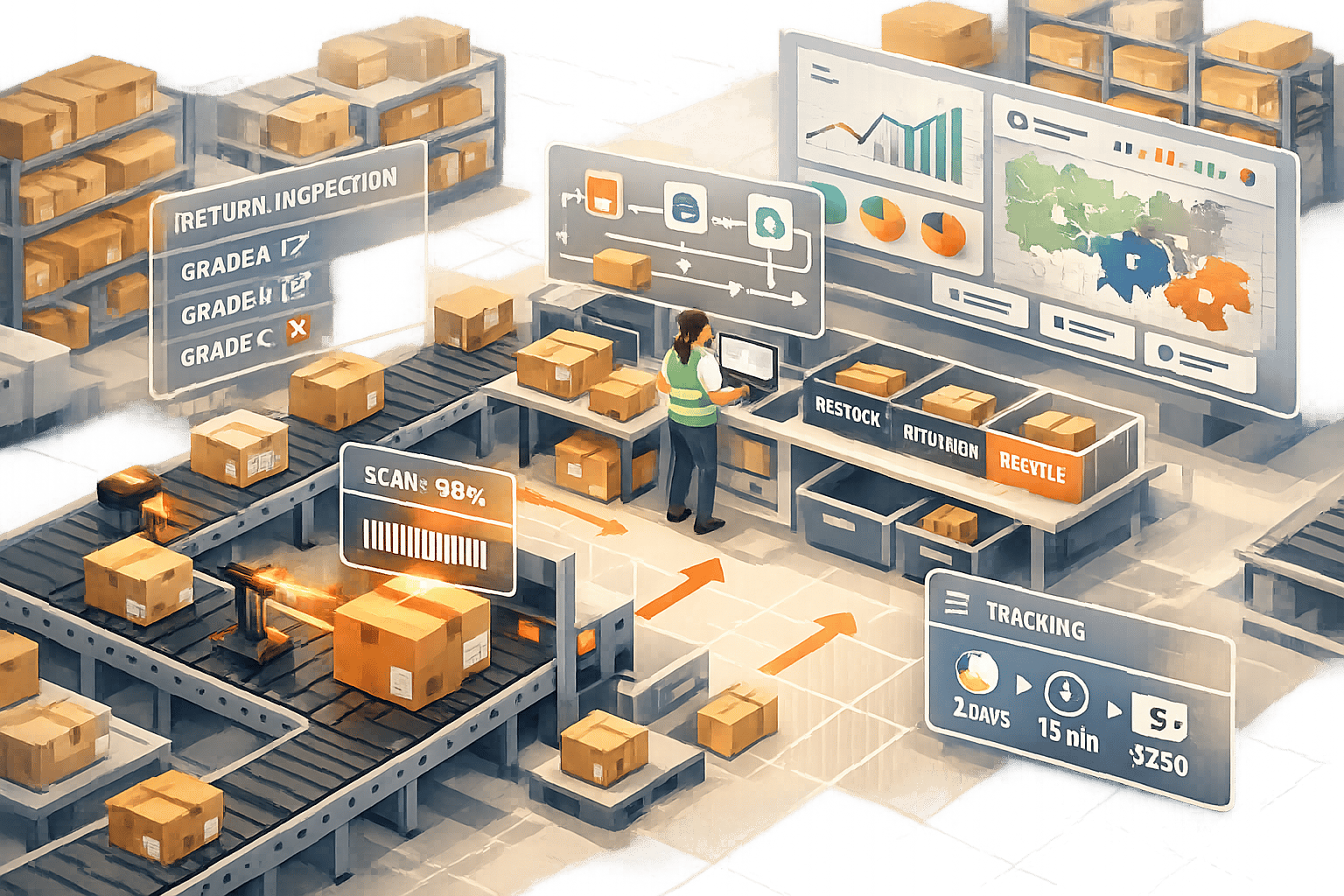
AI-powered warehouse automation delivers financial benefits in several areas. In logistics, AI has reduced overall costs by 15%, while inventory optimization has cut inventory levels by 35%. Predictive maintenance trims maintenance costs by 10% to 20% and slashes equipment downtime by half. AI-driven energy management systems predict and optimize warehouse energy use, significantly lowering utility bills. Automated returns processing, powered by vision technology, determines whether items can be restocked, refurbished, or recycled, reducing reverse logistics costs.
Amazon exemplifies these benefits, with over 200,000 robots deployed in its warehouses as of late 2025. This investment helps manage peak-season volume surges and reduces per-order fulfillment costs. These savings underscore the operational efficiencies AI can unlock.
Operational Efficiency Gains
AI does more than cut costs - it boosts operational performance. Smarter staffing schedules based on demand forecasts allow facilities to handle higher volumes without increasing headcount. Autonomous robotics and AI software can improve picking productivity by up to 130%, while computer vision ensures inventory accuracy of 99.9% through real-time tracking. AI can also pinpoint bottlenecks, such as delayed SKUs, and suggest immediate fixes like relocating items closer to packing areas.
Real-world examples highlight these gains. Deutsche Post DHL uses AI-powered predictive maintenance to maximize sorter machine uptime by identifying potential failures early. Lowe's, leveraging Blue Yonder’s AI software, automated store replenishment based on real-time POS and inventory data, saving $4 billion annually. Additionally, AI automates backend tasks like extracting data from bills of lading, packing lists, and invoices, speeding up document validation and eliminating manual entry.
Implementation Complexity
Rolling out AI in warehouse automation starts with clean, standardized data. 3PLs must align item, customer, and location codes to ensure accurate model training. Focusing on high-value, feasible use cases - like automated document processing, vision-enabled inspections, and predictive maintenance - can simplify early adoption and build momentum for tackling more complex projects later. Engaging warehouse supervisors during the implementation of AI-generated pick paths or staffing plans fosters trust and ensures effective use on the warehouse floor.
"AI only creates value when it changes what happens next. Knowing that a lane will spike in volume is helpful. Automatically adjusting staffing plans, release times, or follow-ups is far more powerful."
– Hector Sunol, CEO, Cyzerg
Scalability Across 3PL Operations
AI systems are designed to grow with operations. Cloud-based infrastructure and APIs make advanced automation accessible to mid-sized 3PLs without requiring massive IT investments. Orchestration platforms connect WMS, TMS, and ERP systems into one cohesive layer, enabling AI insights to trigger workflows across the entire operation rather than creating isolated silos. By 2028, smart robots are projected to outnumber frontline workers in logistics, manufacturing, and retail. Currently, 46% of 3PL providers have adopted AI in some capacity, and 74% of shippers are open to switching to 3PLs with stronger AI capabilities. Integrating warehouse automation into a broader AI strategy allows 3PLs to achieve a streamlined and cost-efficient operational model.
5. Predictive Maintenance
Predictive maintenance transforms 3PL operations by moving from reactive problem-solving to proactive care. Using real-time IoT sensor data - such as vibration, temperature, and acoustic signals - it identifies potential equipment failures before they occur. This condition-based strategy ensures technicians step in only when necessary, cutting down on unnecessary interventions and driving immediate cost savings.
Cost Savings Potential
By addressing issues early, 3PLs can sidestep hefty expenses like towing broken-down vehicles, rushing parts replacements, or paying overtime for emergency fixes. This approach also extends the lifespan of major assets, including warehouse robotics and sorting systems, ensuring a better return on investment. The results come quickly too - many 3PLs report measurable benefits within just 2 to 3 months of implementing predictive maintenance. For instance, in 2025, DINGO, a global leader in predictive maintenance, teamed up with Queensland University of Technology (QUT) to refine its machine learning tools. This collaboration delivered impressive business outcomes within a similar timeframe, while managing billions in heavy equipment worldwide.
Operational Efficiency Gains
Beyond saving costs, predictive maintenance significantly boosts operational reliability. Gartner has labeled predictive maintenance in warehouses as a "Likely Win" due to its practicality and business impact. By scheduling repairs during planned maintenance windows, it eliminates the chaos of unexpected downtime. Advanced tools like audio AI detect machinery defects through sound analysis, catching issues that visual inspections might miss. Automated inspection portals add another layer of efficiency by scanning railcars and vehicles in real time, identifying structural problems before they leave the facility.
"From analyzing vehicle vibrations for maintenance planning to processing machinery sounds to detect hidden defects, audio AI offers a solution that can save time, resources, and - most importantly - lives." – Dmytro Ivanov, Machine Learning Engineer, Trinetix
Scalability Across 3PL Operations
Predictive maintenance isn't just effective - it’s scalable. By consolidating data from various operations, it delivers clear performance improvements. For mid-sized providers, cloud-based platforms and 3PL integration via open APIs make the technology accessible. Starting small with standardized historical maintenance records and sensor logs ensures AI models generate accurate predictions. Focusing first on high-impact assets provides proof of ROI before expanding to other areas. This strategic rollout helps 3PLs maximize the benefits of predictive maintenance across their operations.
6. SLA Monitoring with Forthmatch
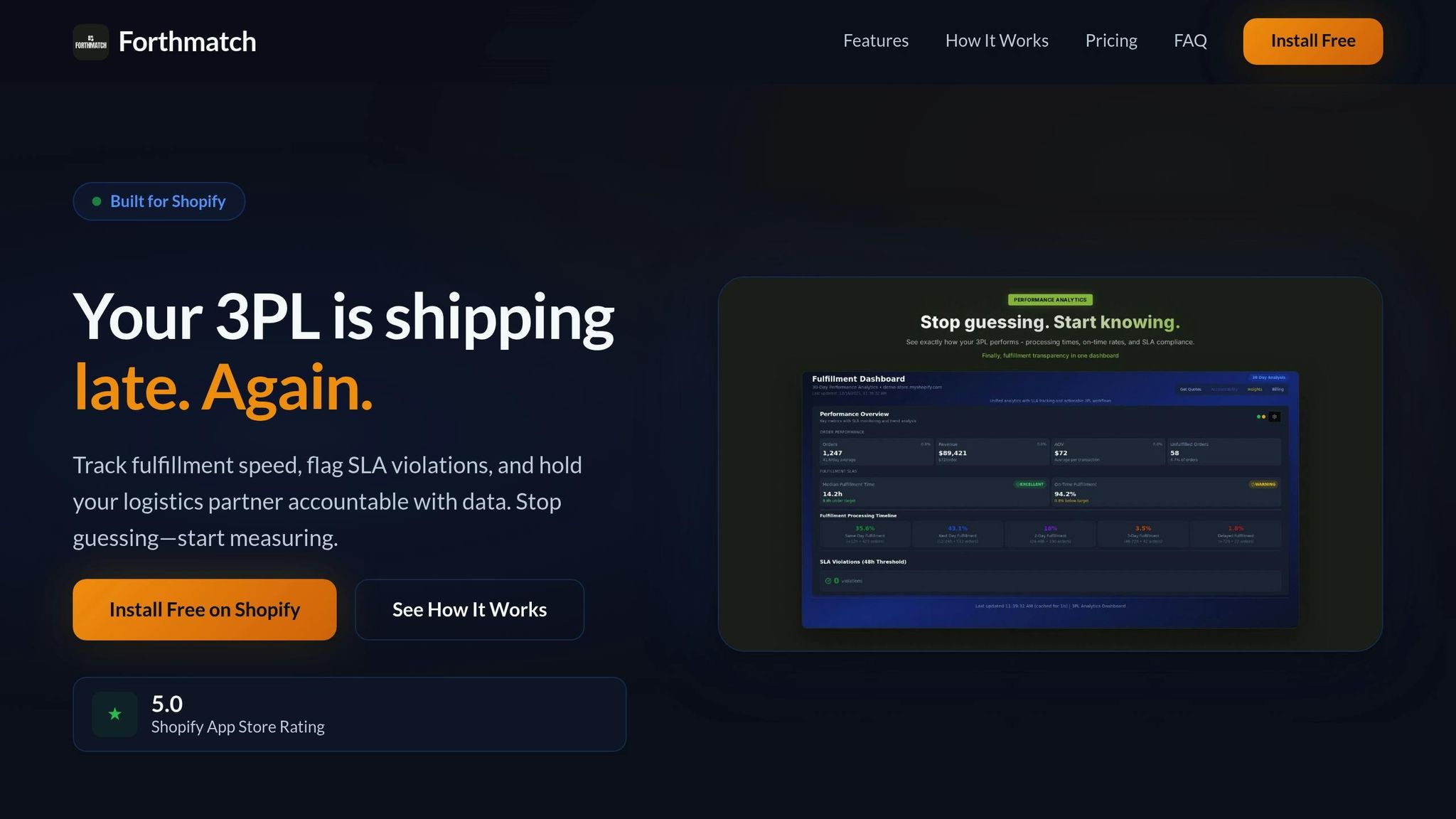
After leveraging tools like route optimization, inventory management, and predictive maintenance to cut costs, SLA monitoring adds another layer of precision to 3PL performance by holding providers accountable with data-backed insights.
Service Level Agreement (SLA) monitoring plays a vital role in 3PL cost optimization, yet it often flies under the radar. Many providers still rely on manual checks or quarterly reviews, which can leave gaps in performance tracking. Forthmatch, a Shopify App designed for this purpose, automates the process by monitoring the time between "Order Created" and "Fulfillment" timestamps. It flags any SLA violations based on your specific targets, such as ensuring shipments go out within 24 hours.
Cost Savings Potential
The financial upside of SLA monitoring goes beyond avoiding penalties for late shipments. By uncovering patterns in delays - whether they stem from weekend processing slowdowns, carrier-specific problems, or seasonal congestion - Forthmatch pinpoints the root causes of inefficiencies. This means fewer expenses tied to expedited shipping fixes or extra customer service efforts. Additionally, Forthmatch provides detailed carrier performance insights, helping you make smarter decisions about which partners consistently meet expectations.
Operational Efficiency Gains
Traditional SLA tracking often involves pulling data manually, analyzing spreadsheets, and making subjective calls about provider performance. Automated tools like Forthmatch eliminate these time-consuming tasks, offering near-real-time visibility into shipments. This allows you to address potential issues before they escalate. As part of a broader AI strategy, Forthmatch integrates seamlessly with other supply chain tools, streamlining operations further. The app also offers one-click email alerts to track 3PL responsiveness and includes an "Accountability Session" feature ($89 per session). This feature captures baseline performance metrics and generates detailed PDF reports after a 2–4 week monitoring period - perfect for quarterly reviews or renegotiating contracts and managing hidden fees.
Implementation Complexity
Unlike many enterprise logistics platforms that require complicated integrations, Forthmatch is designed to work effortlessly with any 3PL or fulfillment center using Shopify. It doesn’t need custom APIs or advanced setups; instead, it uses Shopify's native timestamps to analyze up to 90 days of order data right away. With Performance Insights available for $19 per month (including a 14-day free trial), getting started is straightforward and cost-effective compared to traditional business intelligence tools. Merchants can set their own SLA targets, and the system automatically flags violations without requiring ongoing manual adjustments.
Scalability Across 3PL Operations
One of the advantages of AI-driven logistics tools is their ability to scale alongside your business without adding extra complexity. Forthmatch is no exception. Whether you’re handling 100 orders or 10,000 per month, the platform grows with you. Its RFP Generator tool ($44 per request) uses real order data to create standardized requests for proposals, giving merchants a clear way to benchmark 3PL performance. This scalable design ensures that as your operations expand, your SLA monitoring remains efficient and effective, laying the groundwork for measurable performance gains discussed in the next section.
Before and After AI: Performance Metrics
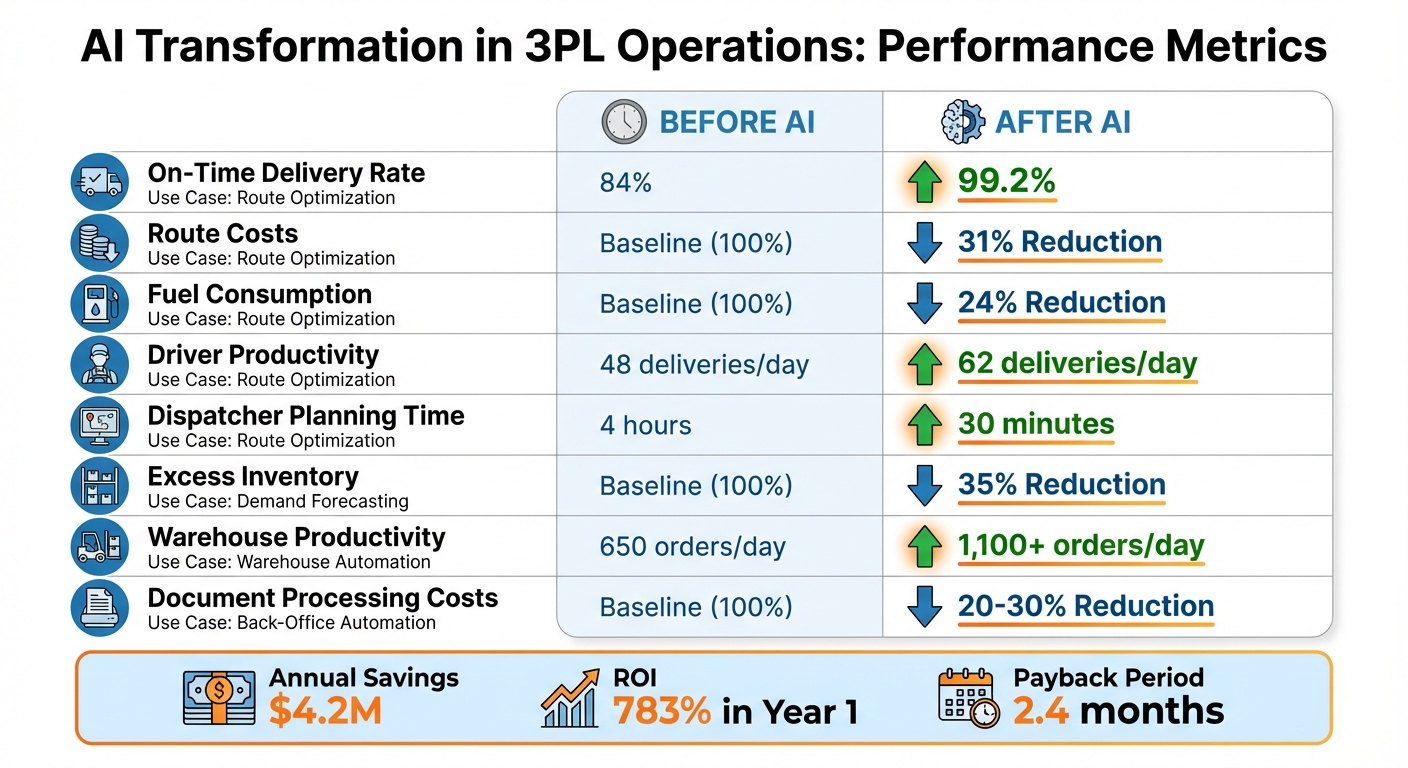
AI Impact on 3PL Operations: Before and After Performance Metrics
Taking a closer look at performance metrics before and after integrating AI shows how much operations and finances can improve. Take the example of a mid-sized 3PL provider: they boosted on-time delivery rates from 84% to an impressive 99.2%, cut route costs by 31%, and saved $4.2 million annually. This resulted in a staggering 783% ROI in the first year, with a payback period of just 2.4 months. These gains highlight the wide-ranging impact AI can have across different use cases.
Other examples reinforce this trend of improved efficiency and cost reduction. In 2025, Argents Express Group, a U.S.-based logistics provider, turned to the Osa Unified Commerce Platform to handle a sudden influx of 20,000 overnight orders. Thanks to AI-driven automation, their pack-table productivity jumped by 57%, increasing daily output from 650 orders to over 1,100 while completely eliminating mis-shipments. Similarly, UPS's ORION route optimization tool saves a whopping 10 million gallons of fuel annually by factoring in real-time traffic and delivery schedules.
Here’s a snapshot of how AI has transformed key metrics across 3PL operations:
| Metric | Before AI | After AI | Primary Use Case |
|---|---|---|---|
| On-Time Delivery Rate | 84% | 99.2% | Route Optimization |
| Route Costs | Baseline | 31% Reduction | Route Optimization |
| Fuel Consumption | Baseline | 24% Reduction | Route Optimization |
| Driver Productivity | 48 deliveries/day | 62 deliveries/day | Route Optimization |
| Dispatcher Planning Time | 4 hours | 30 minutes | Route Optimization |
| Excess Inventory | Baseline | 35% Reduction | Demand Forecasting |
| Warehouse Productivity | 650 orders/day | 1,100+ orders/day | Warehouse Automation |
| Document Processing Costs | Baseline | 20–30% Reduction | Back-Office Automation |
Beyond operational metrics, AI also delivers financial advantages. For instance, it reduces inventory carrying and storage costs and accelerates invoicing cycles. These improvements explain why 74% of shippers are rethinking their current 3PL partnerships, favoring providers with stronger AI capabilities. It's clear that AI is reshaping logistics, offering both efficiency and cost savings that are hard to ignore.
Conclusion
AI is reshaping how 3PL providers manage costs and deliver results. By leveraging advanced tools like route optimization and predictive maintenance, these technologies tackle longstanding operational hurdles, enabling providers to shift from reactive fixes to forward-looking management. This shift helps them anticipate disruptions before they occur, protecting both high fulfillment costs and customer trust.
Consider the numbers: one mid-sized 3PL saved $4.2 million annually while boosting on-time delivery rates from 84% to an impressive 99.2%. Similarly, Argents Express Group saw a 57% jump in pack-table productivity, increasing daily orders from 650 to over 1,100 while completely eliminating mis-shipments. These examples illustrate the sweeping impact of AI across key areas like route optimization and inventory management.
But achieving and maintaining these gains requires accountability. AI-driven optimization only works when performance is measurable and verifiable. Without real-time visibility into service-level agreements (SLAs), even the most advanced AI systems fall short. Reliable data is crucial to validate 3PL performance, pinpoint delays, and support evidence-based conversations during contract reviews.
This is where Forthmatch steps in for Shopify merchants. Priced at $19 per month with a 14-day free trial, it provides real-time monitoring of fulfillment speeds, flags SLA violations, and categorizes delay causes into actionable insights like "15% of orders missed the 24-hour SLA." It works seamlessly with any 3PL fulfilling Shopify orders - no custom integration required. When common 3PL conflicts arise, one-click email alerts notify your account manager, creating a documented record. For deeper insights, the Accountability Session feature ($89 per session) generates detailed PDF reports to track performance changes over time.
As Dmytro Ivanov, Machine Learning Engineer at Trinetix, puts it:
"Artificial intelligence makes this possible by effectively speeding up every process and supplying you with unseen data that turns the tables on your logistics operations".
The takeaway? Pairing AI-driven optimization with robust performance monitoring is essential for staying competitive in the 3PL space.
FAQs
What is Forthmatch?
Forthmatch is a Shopify app designed to keep tabs on your 3PL's performance. It keeps track of order fulfillment times, highlights SLA violations, and delivers analytics to identify bottlenecks. By transforming vague concerns into clear, actionable data, it empowers you to hold your logistics partners accountable and streamline your operations.
How does it work?
Forthmatch keeps an eye on order timestamps in Shopify, measuring the time between when an order is marked as "Created" and when it moves to "Fulfillment." You can set your own SLA targets, like "ship within 24 hours", and the app takes it from there. If a target isn't met, you'll get automatic alerts, helping you stay on top of your 3PL's performance and quickly tackle any delays.
What does it cost?
Forthmatch operates on a subscription and pay-per-use pricing structure:
- Performance Insights: $19/month, which includes a 14-day free trial.
- Accountability Sessions: $89 per session.
- RFP Quote Requests: $44 per request.
While there’s no free plan, the 14-day trial allows you to explore all features without any risk.
Does it work with my 3PL?
Forthmatch is compatible with any 3PL or fulfillment center that handles orders via Shopify. It leverages Shopify's built-in order timestamps, meaning there's no need for a custom integration with your 3PL's software.
Can I alert my 3PL about delays?
Yes, you can send one-click email alerts directly to your 3PL account manager whenever an order breaches the SLA. The app not only tracks these alerts but also logs whether the provider responds, giving you a clear record of their responsiveness.
What are "Accountability Sessions"?
"Accountability Sessions" are optional paid services designed to evaluate and enhance your 3PL's performance. The process begins by setting a baseline, followed by monitoring over a 2-4 week period. At the end, you'll receive a detailed PDF report that compares metrics from before and after the monitoring phase. These reports are especially helpful for conducting business reviews or renegotiating contracts.