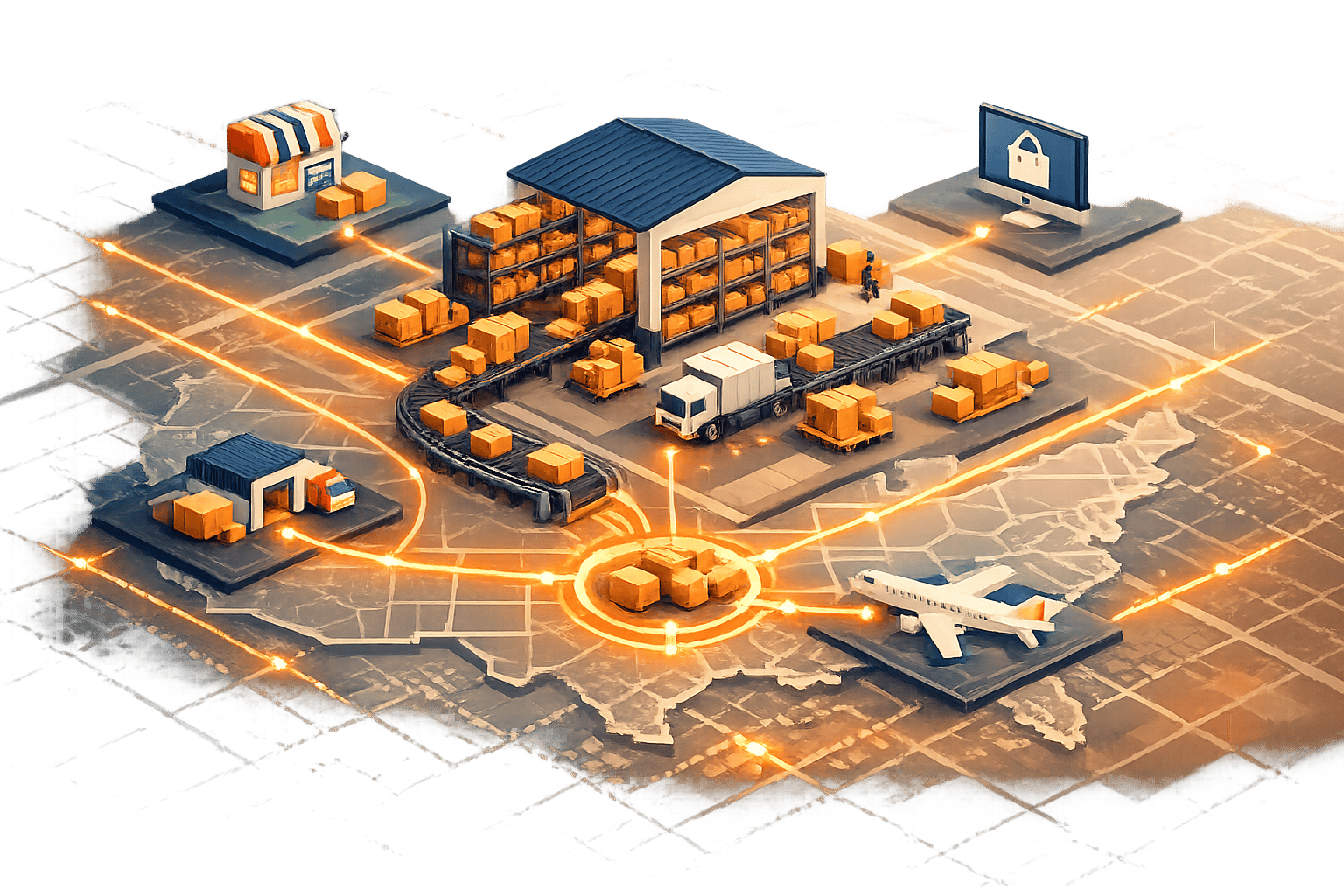
Managing Shopify and Amazon fulfillment separately can be a headache for DTC brands. Switching between platforms wastes time, increases errors, and creates data silos. Unified dashboards solve this by consolidating fulfillment data into one place. They provide real-time insights, automate processes, and reduce risks like overselling or delivery delays. Here's what you need to know:
- Shopify's Fulfillment Dashboard: Great for DTC brands, it integrates with 3PLs via apps or APIs, syncs inventory in real-time, and automates order routing. However, analytics and error tracking may require third-party tools.
- Amazon Seller Central (FBA Dashboard): Offers detailed inventory and performance tracking but can feel complex without a unified system.
- Forthmatch Dashboard: Focuses on 3PL accountability, flagging SLA violations and tracking performance trends across platforms.
Quick Takeaway: Combining Shopify, Amazon, and tools like Forthmatch into a unified system simplifies operations, improves fulfillment accuracy, and helps brands maintain service levels across channels.
What Is Omnichannel Fulfillment? Ecommerce Strategy for Amazon, Shopify, Retail & DTC Brands
1. Shopify Fulfillment Dashboard
Shopify's built-in fulfillment dashboard acts as the command center for direct-to-consumer (DTC) brands managing their sales channels. From processing orders to providing tracking updates, it keeps operations running smoothly. One of its standout features is how seamlessly it integrates with external fulfillment systems. Let’s dive into how these integration methods boost the dashboard’s functionality.
Integration Method
Shopify connects with third-party logistics (3PL) providers and fulfillment services through four main approaches. The simplest route is using apps like "Built by Amazon" solutions, such as Multi-Channel Fulfillment (MCF) and Buy with Prime. These apps are free to download from the Shopify App Store and require minimal setup. For businesses looking for more tailored options, third-party apps like WebBee and ByteStand offer advanced features for automated workflows. For instance, Dragon Glassware used WebBee to link its Shopify store with MCF, enabling real-time tracking and automated processes across multiple sales platforms.
For larger enterprises, custom API connections provide complete control over integrations, while mid-sized companies often turn to inventory management tools like Veeqo or ShipStation to bridge the gap between Shopify and their fulfillment operations.
Inventory Sync Speed
Once integrated, real-time inventory synchronization becomes critical. Modern Shopify integrations use event-driven updates via webhooks, ensuring inventory levels adjust instantly whenever stock changes - whether from incoming shipments, order processing, or manual updates. This real-time syncing reduces the risk of overselling by maintaining accurate stock levels across all channels. Some tools even offer flexible sync settings, allowing high-volume businesses to update inventory hourly, while smaller operations might only need daily updates.
Order Management
The dashboard simplifies order management by automatically routing Shopify orders to connected 3PL providers, eliminating the need for manual data entry. For example, Wyze, a smart home device retailer, integrated its Shopify store with Amazon MCF, cutting delivery times by 50%. The system also handles product catalogs, returns, and tracking number updates, syncing everything back to Shopify. Advanced setups can split multi-item orders across warehouses or reserve inventory while awaiting payment clearance.
Analytics Depth
Shopify’s built-in analytics provide basic fulfillment metrics, but specialized apps take it a step further. For instance, the Forthmatch 3PL Dashboard ($19/month) offers real-time monitoring of service level agreements (SLAs) and tracks on-time fulfillment rates against industry standards. A fulfillment rate of 95% or higher is considered excellent, while anything below 85% may signal critical issues. Beyond just flagging late orders, the platform digs deeper, identifying root causes like staffing shortages or equipment problems.
Eve Munguia, Director of Operations at Lynch Creek Farm, shared, "The custom reporting capabilities, especially with the new AI-powered SQL report generation, have been incredible. I can now build reports in minutes that used to take significant time to configure."
Fulfillment Error Tracking
Shopify’s error tracking has become more sophisticated, moving beyond simply flagging late orders. Modern systems monitor orders against SLA benchmarks - typically 24–72 hours for standard shipping - and send alerts when 3PLs miss deadlines. The Forthmatch dashboard, which boasts a 5.0/5-star rating on the Shopify App Store, offers one-click email alerts to notify logistics providers of SLA violations instantly.
A merchant from vybey AU, Braincare Nutrition, noted, "We knew our 3PL wasn't meeting SLAs but had no way to hold them accountable. Forthmatch's alert system changed that. Now every missed deadline gets flagged, and we can track their response rate."
2. Amazon Seller Central (FBA Dashboard)
Amazon Seller Central is more than just a management tool for Fulfillment by Amazon (FBA); it's a central hub for brands relying on Amazon's fulfillment services. When integrated with unified dashboards, it transforms FBA from an isolated system into one seamlessly connected to Shopify and other sales channels. This approach allows businesses to treat FBA as just another warehouse in their network, simplifying operations and improving efficiency.
Integration Method
Connecting Amazon Seller Central to a unified dashboard can be done through several methods. The Selling Partner API (SP-API) enables direct, real-time connections, eliminating the hassle of manual CSV uploads. For Shopify merchants, Amazon provides the free "Built by Amazon" MCF app, which simplifies integration for U.S.-based orders. Advanced ERP systems like Fulfil.io take it a step further, treating FBA as a virtual 3PL (third-party logistics) warehouse. These systems handle everything from inbound shipments to tracking receiving statuses and removals - all within a single interface.
"Most Amazon tools treat FBA like a black box... Fulfil treats FBA like any other warehouse or 3PL in your system." – Fulfil.io
This level of integration ensures real-time updates and a streamlined workflow.
Inventory Sync Speed
Keeping inventory synced in real-time is essential to avoid overselling. Unified dashboards excel at this by offering event-driven updates that trigger instantly when Amazon receives or ships inventory. They also provide scheduled syncs for added flexibility. High-volume sellers benefit from multi-bucket imports, which can capture orders as frequently as every 15 minutes, hourly, or up to 30 days. This is particularly important because Amazon categorizes inventory into "Available", "Reserved", and "Inbound" states. Without accurate, real-time visibility, overselling can quickly become a problem.
With this consistent level of inventory tracking, order processing becomes almost entirely automated.
Order Management
Unified dashboards simplify order management by automating the flow of orders between platforms. For example, Shopify orders can be routed directly to Amazon MCF without the need for manual address entry. They also manage "provisional" Prime orders by reserving inventory for up to 21 days while Amazon verifies payment. This prevents overselling across channels. Additionally, these systems automate tasks like bi-weekly settlement reconciliation, matching payments to invoices, and recording FBA fees, advertising charges, and reimbursements directly into the general ledger.
Analytics Depth
While Amazon Seller Central provides metrics specific to FBA, unified dashboards offer a broader view. Merchants can monitor sales performance across all platforms, compare FBA's on-time delivery rate (which exceeds 97%), and make smarter restocking decisions based on real-time inventory states instead of aggregated data. The Inventory Ledger report, introduced in early 2023, consolidates multiple older reports into a single source of truth. This report automatically tracks adjustments for lost, damaged, or disposed items, making inventory management easier.
Fulfillment Error Tracking
Amazon's "Shipping Queue" and "Inbound Performance" reports help track inventory from creation to closure (which happens automatically after 45 days for domestic shipments). Unified dashboards enhance this by flagging SLA breaches and missing tracking IDs automatically. They also generate insights from Amazon's "Stranded Inventory" report, which identifies units stuck in fulfillment centers without active listings. Additionally, the "Contents" tab in the Shipment Summary highlights statuses marked as "Action Required", ensuring sellers can address issues promptly.
For multi-channel sellers, this automated error detection eliminates the need to constantly switch between platforms. As Sumtracker's Bhoomi Singh explains:
"Shopify and Amazon each have their own dashboards, rules, and data formats. You're constantly switching contexts to piece things together."
sbb-itb-eb0f906
3. Forthmatch Dashboard
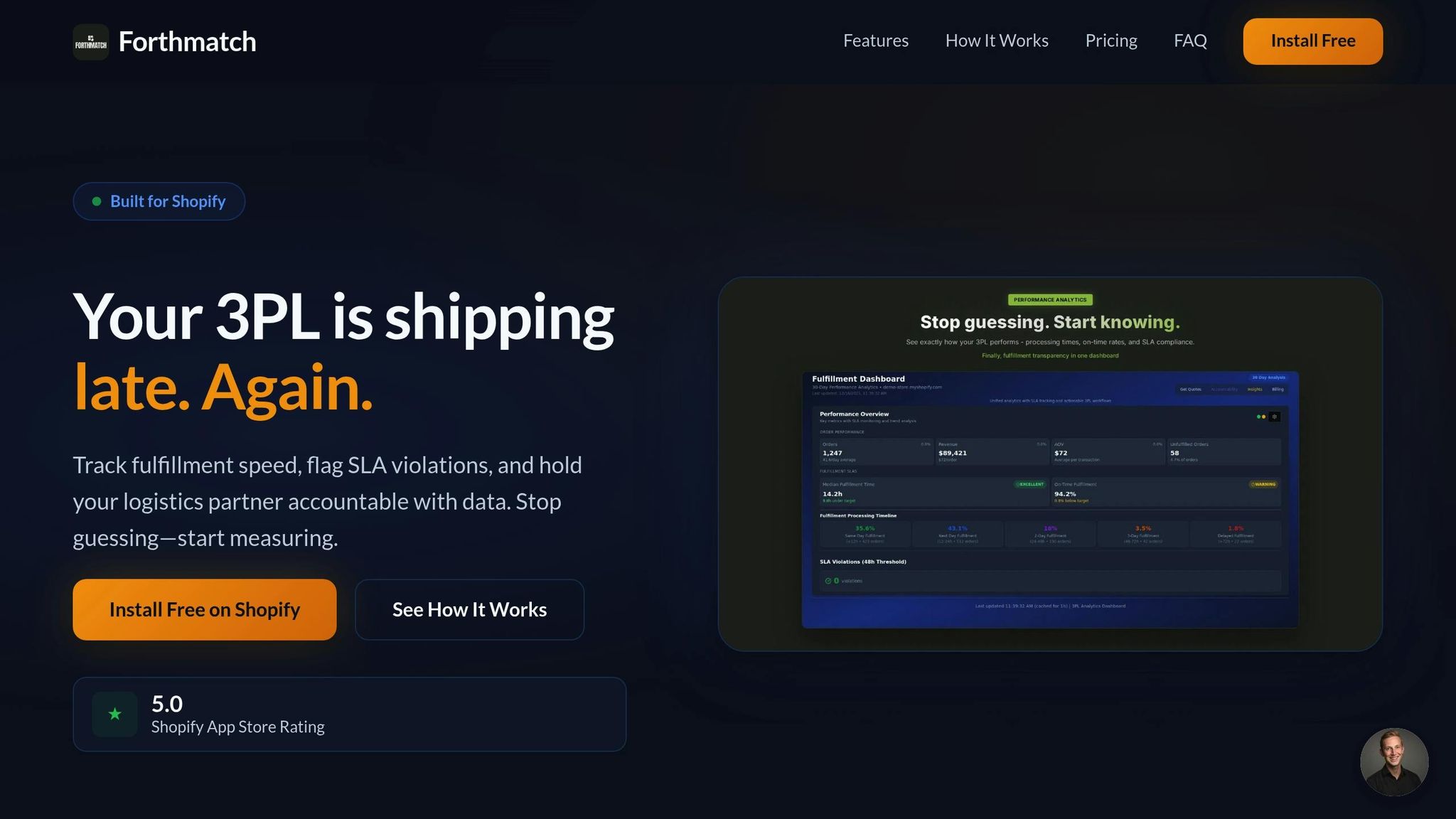
Forthmatch takes a fresh approach to tracking fulfillment by focusing on 3PL accountability rather than just order tracking. Unlike Shopify and Amazon's native dashboards, this platform zeroes in on evaluating how well your third-party logistics (3PL) providers are performing. It seamlessly tracks fulfillment partner performance across both Shopify and Amazon platforms. With a one-click Shopify installation and API-based Amazon MCF data integration, Forthmatch eliminates the hassle of manual CSV uploads, saving time and effort. This cross-platform functionality provides actionable insights, breaking down data silos and supporting a more unified fulfillment strategy.
Next, let’s look at how Forthmatch simplifies data integration.
Integration Method
Forthmatch makes integration simple and effective. For Shopify, it reads order timestamps and analyzes up to 90 days of historical data as soon as it’s installed. On the Amazon side, the platform syncs MCF data automatically through its API connection. This unified system lets you monitor Amazon’s fulfillment performance alongside your other 3PL providers in one dashboard. By treating Amazon FBA as just another warehouse in your network, Forthmatch eliminates the need to manage it as a separate system.
With integration handled, Forthmatch shifts focus to delivering detailed performance analytics.
Analytics Depth
Forthmatch evaluates 3PL performance using clear, measurable categories: Excellent (≥95%), Good (90–94%), Needs Improvement (85–89%), or Critical (<85%). Fulfillment times are broken down into three categories - Same-day (under 24 hours), Standard (24-72 hours), and Economy (72-120 hours) - and trends are tracked over 7, 14, 30, and 90-day periods. The platform also identifies delays, categorizing them by cause, such as carrier issues, operational failures, or weekend bottlenecks.
"We knew our 3PL wasn't meeting SLAs but had no way to hold them accountable. Forthmatch's alert system changed that. Now every missed deadline gets flagged... Our provider went from ignoring issues to actually responding with action plans." – vybey AU, Braincare Nutrition
Fulfillment Error Tracking
Forthmatch flags orders that exceed SLA thresholds, such as 24 hours for premium shipping or 72 hours for standard shipping, and sends one-click email alerts directly to 3PL managers. It even tracks their response rates to ensure accountability. For recurring issues, the $89 "Accountability Session" feature provides a detailed performance review over 30 days. This includes baseline metrics and progress reports you can use during contract negotiations. Additionally, the platform offers a "3PL Data Coverage" indicator. If this metric drops below 90%, it signals that more fulfillment data needs to be synced to maintain accurate analytics.
Pros and Cons
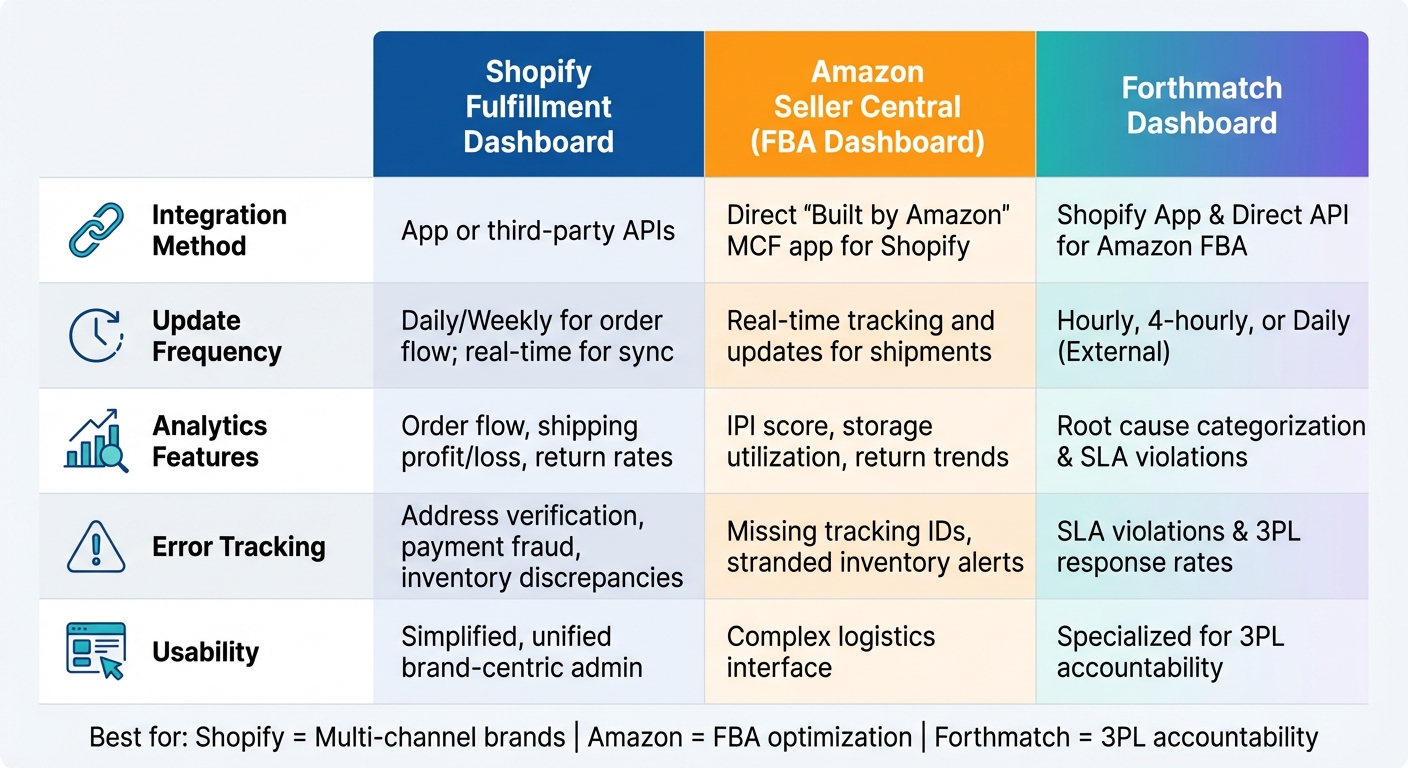
Shopify vs Amazon vs Forthmatch Dashboard Comparison for Fulfillment Management
When it comes to managing fulfillment across platforms, each dashboard has its strengths and weaknesses. Here's a breakdown of how Shopify, Amazon Seller Central, and Forthmatch stack up, highlighting why a unified monitoring solution can be so impactful for DTC brands.
Shopify's Fulfillment Dashboard simplifies multi-channel order management by bringing everything into one admin interface. However, it has its shortcomings. For instance, inventory from canceled or returned orders isn’t restocked automatically, which means manual updates are necessary to prevent overselling. Another downside is its analytics - while functional, they often require custom reports to analyze key metrics like monthly shipping profit and loss.
Amazon Seller Central (FBA Dashboard) excels in providing real-time tracking and operational insights, with metrics like the Inventory Performance Index (IPI) and storage utilization ratios. But it’s not without challenges. The platform’s multiple tools and dashboards can feel overwhelming, and reconciling bi-weekly settlement reports often requires third-party ERP tools, adding complexity to the process.
Forthmatch takes a different approach, focusing entirely on 3PL accountability rather than general order management. It flags SLA violations in real time, categorizes delays by root causes, and tracks how quickly 3PLs respond to issues. A standout feature is its "Accountability Session" ($89), which establishes baseline performance and tracks improvements over 30 days - particularly useful for contract negotiations. However, it’s tailored for brands that rely on external 3PLs and requires a $19/month subscription for its Performance Insights feature.
Here’s a quick comparison of the key features:
| Feature | Shopify Fulfillment | Amazon Seller Central (FBA) | Forthmatch Dashboard |
|---|---|---|---|
| Integration Method | App or third-party APIs | Direct "Built by Amazon" MCF app for Shopify | Shopify App & Direct API for Amazon FBA |
| Update Frequency | Daily/Weekly for order flow; real-time for sync | Real-time tracking and updates for shipments | Hourly, 4-hourly, or Daily (External) |
| Analytics Features | Order flow, shipping profit/loss, return rates | IPI score, storage utilization, return trends | Root cause categorization & SLA violations |
| Error Tracking | Address verification, payment fraud, inventory discrepancies | Missing tracking IDs, stranded inventory alerts | SLA violations & 3PL response rates |
| Usability | Simplified, unified brand-centric admin | Complex logistics interface | Specialized for 3PL accountability |
The bottom line? Shopify is best suited for brands juggling multiple sales channels, Amazon shines when optimizing FBA logistics, and Forthmatch is the go-to for holding 3PL providers accountable. Together, these tools underscore the value of having a unified fulfillment monitoring system to tie everything together and improve operational efficiency.
Conclusion
Unified dashboards make fulfillment smoother by bringing Shopify order tracking, Amazon inventory management, and Forthmatch 3PL accountability into a single, real-time view. Shopify handles order tracking, Amazon fine-tunes inventory and costs, while Forthmatch ensures third-party logistics providers (3PLs) meet service level agreements (SLAs) through automated monitoring and root cause analysis .
When choosing a dashboard strategy, consider your business's scale and specific fulfillment needs. For newer direct-to-consumer (DTC) brands, Shopify's built-in tools combined with Amazon's FBA system might cover the basics. But if you're working with external 3PLs or dealing with frequent shipping delays, having data-driven accountability becomes crucial. For instance, Forthmatch’s Performance Insights plan, priced at $19/month, offers instant analysis of up to 90 days of Shopify order history and sends automatic alerts for missed deadlines.
If your brand is nearing contract renewals or dealing with unresponsive logistics partners, Forthmatch’s Accountability Session, available for $89, could be a game-changer. This add-on establishes a performance baseline, tracks improvements over 30 days, and provides actionable data for negotiations. As mentioned earlier, its alert system flags missed deadlines and monitors response rates, giving you the leverage to hold your 3PLs accountable.
For brands primarily selling through Amazon FBA, focusing on Seller Central’s Inventory Performance Index and storage metrics can help refine your fulfillment approach. Meanwhile, businesses managing multiple 3PLs can benefit from a unified monitoring system that eliminates the hassle of switching between portals, offering side-by-side performance comparisons . The goal is to align your tools with operational needs, enabling faster decisions and building stronger partnerships with your logistics providers.
FAQs
How do unified dashboards help DTC brands improve fulfillment accuracy?
Unified dashboards make life easier for DTC brands by pulling data from platforms like Shopify and Amazon into one real-time system. This setup helps brands catch order errors, keep an eye on SLA compliance, and quickly address issues, cutting down on inventory mismatches and delivery slip-ups.
With a single, centralized view of operations, these dashboards make it easier to track performance, ensure on-time deliveries, and keep customers happy. For businesses juggling fulfillment across multiple platforms, this kind of visibility and control is a game-changer for scaling efficiently.
How can I connect Shopify and Amazon to a unified fulfillment dashboard?
To bring Shopify and Amazon together into a single fulfillment dashboard, you have three main options to consider:
- API integrations: Both Shopify and Amazon offer APIs that can sync orders, inventory, and shipping details in real-time. This keeps your dashboard updated automatically, eliminating the need for manual updates.
- Pre-built connectors: There are tools available that come with ready-to-use integrations to link Shopify and Amazon. These are simple to set up and don’t require any coding knowledge.
- File imports/exports: If you prefer a more hands-on approach, you can schedule CSV or Excel file uploads to align Shopify sales data with Amazon’s fulfillment reports.
Forthmatch supports all these methods, making it easier for DTC brands to manage and track fulfillment from both platforms in one centralized location.
How does Forthmatch improve 3PL accountability for e-commerce brands?
Forthmatch takes 3PL accountability to the next level with customizable SLA thresholds that automatically detect and notify you of any breaches. With tools like detailed root-cause analysis, baseline performance tracking, and before-and-after comparison reports, it provides clear insights you can act on. These features make it easier to hold your logistics partners accountable and approach contract negotiations with confidence.
While most dashboards stick to offering real-time visibility, Forthmatch goes further. It equips you with data-driven performance benchmarks and historical trends, ensuring your fulfillment operations stay on track and ready to scale.