When you're working with a third-party logistics (3PL) provider, data is your strongest tool for holding them accountable and negotiating better contracts. By analyzing order tracking data, you can identify delays, measure performance, and enforce Service Level Agreements (SLAs). Here’s how tracking data can help:
- Pinpoint SLA Violations: Use timestamps like
CARRIER_PICKED_UPto measure actual fulfillment times and spot delays beyond agreed thresholds. - Set Clear Benchmarks: Metrics like median (P50) and 95th percentile (P95) processing times help define realistic performance expectations.
- Automate Monitoring: Tools like Forthmatch track fulfillment data in real time, flagging missed SLAs and creating detailed reports.
- Strengthen Negotiations: Data-backed insights allow you to demand improved performance, negotiate penalties, resolve 3PL conflicts, or explore alternative providers. When switching, it is vital to evaluate 3PL reach and technology capabilities.
Top 3 Carrier and 3PL Contract Negotiation Pitfalls: Leveraging Fulfillment Data Analytics
sbb-itb-eb0f906
Step 1: Collect and Organize Your Tracking Data
To hold your 3PL accountable, you need a clear understanding of how your orders are being handled. While Shopify provides detailed fulfillment data, its interface doesn't easily translate timestamps into actionable insights. To get the full picture, you'll need to extract, organize, and analyze this data systematically.
Extract Fulfillment Data from Shopify

Shopify records detailed fulfillment events that can reveal how well your 3PL is performing. As of September 2025, Shopify tracks specific statuses like LABEL_PURCHASED, CONFIRMED (when your 3PL marks an order as fulfilled), and CARRIER_PICKED_UP (when the carrier scans the package). These timestamps are crucial for evaluating performance.
Among these, the CARRIER_PICKED_UP timestamp is the most important. It marks the exact moment a package leaves your 3PL's warehouse - not just when a shipping label is created or the order is marked as fulfilled. By comparing the time difference between an order's createdAt timestamp and the happenedAt timestamp of the CARRIER_PICKED_UP event, you can measure how quickly your 3PL processes orders.
Pay close attention to delays longer than four hours between CONFIRMED and CARRIER_PICKED_UP. These delays may indicate inefficiencies, such as creating a label but waiting to hand the package off to the carrier. Identifying these gaps can expose bottlenecks in your 3PL's workflow.
You can manually track this data by sampling 20–30 orders each week in a spreadsheet. Alternatively, tools like Forthmatch automate the process by pulling data directly from Shopify's webhooks. Forthmatch can analyze up to 90 days of historical orders right after installation, calculating fulfillment times without requiring custom integrations with your 3PL's software.
Once you've gathered your raw data, the next step is to establish benchmarks that will help you measure performance consistently.
Create a Performance Baseline
Using historical data, you can turn uncertainty into clear benchmarks. Analyzing 8–12 weeks of order history allows you to identify patterns, seasonal fluctuations, and recurring problems, creating a foundation for meaningful accountability discussions.
Focus on two key metrics: the median (P50) and the 95th percentile (P95) processing times. The median shows the typical performance, while the P95 highlights the longest delays - those most likely to frustrate customers.
Forthmatch offers tools to simplify this process. Their Performance Insights plan ($19/month with a 14-day free trial) provides extended historical analytics and trend reports over custom date ranges. For more in-depth tracking, their Accountability Session add-on ($89 one-time) helps establish a 2–4 week baseline, then monitors improvements for before-and-after comparison reports. These reports are especially useful for quarterly reviews or renegotiating contracts.
When organizing your data, go beyond surface-level metrics. Categorize delays by their root causes, such as labor shortages, equipment breakdowns, missed carrier pickups, or inventory issues. This detailed approach fosters more productive conversations with your 3PL, focusing on solutions rather than just pointing out missed SLAs.
Step 2: Track SLA Violations Automatically
Manually tracking 20–30 orders each week might help you spot obvious problems, but it often overlooks deeper, recurring issues. That’s where automated, real-time monitoring comes in. Tools that use webhook listeners - like fulfillments/create and fulfillment_events/create - can capture fulfillment data the moment it’s generated in Shopify. Once automation handles the tracking, you can focus on defining precise targets and categorizing any violations.
Set SLA Targets and Track Key Metrics
Start by setting two key thresholds: a median target (P50), which reflects your expected average performance, and a maximum acceptable processing time (P95), to catch extreme delays. For example, you might aim for a median target of 24 hours and a maximum processing time of 48 hours.
One critical metric to track is Handoff Time - the time between when an order is created and the CARRIER_PICKED_UP event. This timestamp, introduced in September 2025, marks when a package actually leaves your 3PL’s warehouse. It’s much more accurate than the "fulfilled" status, which only confirms that a shipping label was created. Some 3PLs may claim 95% same-day fulfillment simply by generating labels before midnight, even though packages might sit for up to 21 hours before a carrier actually scans them.
With automated systems, every order that breaches your thresholds is flagged in real time. For example, Forthmatch’s Performance Insights plan ($19/month with a 14-day free trial) tracks these violations as they happen. It also sends one-click email alerts directly to your 3PL’s account manager the moment an SLA is breached. Beyond alerting you, the app monitors how quickly your provider responds, creating a detailed record of their responsiveness. This data can be a game-changer when negotiating clear and enforceable contracts with your 3PL.
Categorize and Measure SLA Violations
Once your SLA thresholds are set and alerts are automated, classify each violation to understand its root cause. Breaking down breaches helps pinpoint whether the issue is something your 3PL can control. Delays can stem from a variety of factors, such as carrier issues, warehouse labor shortages, equipment failures, or weekend bottlenecks. Identifying these causes ensures that you focus only on problems that fall under your provider’s responsibility during contract discussions.
Pay close attention to Label Generation Lag - the time between when a 3PL marks an order as "fulfilled" and when the carrier actually picks it up. If this delay exceeds four hours, it often signals that packages are sitting in the warehouse after being marked as shipped. Monitoring this metric can reveal whether your 3PL is manipulating dashboard data to appear more efficient than they really are.
Step 3: Analyze Performance Trends and Delay Causes
Once you’ve got automated SLA tracking up and running, it’s time to dig into the data. By analyzing performance trends, you’ll get a clear picture of whether your 3PL’s performance is improving, holding steady, or slipping. This approach shifts you away from constantly putting out fires and moves you toward making smarter, data-backed decisions.
Compare Carrier Performance
Not all carriers deliver the same level of service, and tracking your data will highlight these differences. By grouping fulfillment events by carrier, you can calculate on-time delivery rates. For instance, comparing a carrier’s estimatedDeliveryAt timestamp with the actual DELIVERED event can show which carriers consistently meet their deadlines and which fall short.
Let’s say one carrier has recurring problems with damaged packages or address errors in a specific region. That’s actionable data you can use to renegotiate terms or even explore other options. Tools like Forthmatch’s Performance Insights plan ($19/month with a 14-day free trial) make this process even easier by providing a side-by-side comparison of carrier performance. This way, you can quickly identify the best fit for your shipping needs.
These carrier-level insights help you zoom out and see the bigger picture of your operational challenges.
Identify Root Causes of Delays
Once you’ve compared carrier performance, it’s time to dig deeper into the operational data to uncover systemic issues. Break down delays into categories like labor shortages, equipment problems, weekend slowdowns, or regional challenges. This step helps you separate issues under your 3PL’s control from external factors like weather or carrier capacity limitations.
For example, a steady increase in median handoff times week after week signals a deeper, ongoing problem rather than a one-off event. Similarly, sudden spikes in delays might point to scheduling or capacity bottlenecks that need immediate attention.
Step 4: Build Evidence for Contract Negotiations
Now that you’ve identified performance trends, it’s time to turn that information into hard evidence for your contract negotiations. Exportable reports can provide the clear, objective data you need to back up your case.
Create Data-Driven Reports
Start by analyzing SLA breaches and delays, then compile these findings into a report that directly supports your negotiation goals. Focus on four key metrics to make your case: handoff time (from order creation to carrier pickup), label generation lag (from label creation to carrier scan), SLA violation rate (percentage of breached orders), and provider response rate (responsiveness to flagged issues).
Instead of relying solely on averages, use P50 and P95 percentiles for a more accurate picture. The P50 (median) reveals typical fulfillment times, while the P95 uncovers worst-case delays. For example, a 3PL might highlight strong same-day fulfillment rates based on label generation alone, but delays before carrier pickup could undermine these claims. Tools like Forthmatch's Accountability Session ($89 one-time) provide a 2–4 week performance baseline, generating an exportable PDF report perfect for quarterly reviews and contract renegotiations.
Once your data is consolidated, ensure you keep a detailed record of all communication for added leverage.
Document Communication for Accountability
Keep track of every SLA breach alert and the provider’s response - or lack thereof. This creates a clear accountability trail.
"Our provider went from ignoring issues to actually responding with action plans. Data-backed accountability - exactly what we needed."
– vybey AU, Braincare Nutrition
Braincare Nutrition put this into practice in October 2025, using Forthmatch's alert system to flag missed deadlines and monitor their provider’s responses. By timestamping late orders and recording unaddressed alerts, they eliminated excuses and held their provider accountable.
Forthmatch's Performance Insights plan ($19/month with a 14-day free trial) automates this process. It tracks alerts and provider responses, building a detailed log without manual effort. Armed with a PDF report showing a high SLA breach rate and comprehensive communication records, you’ll have the objective evidence needed to demand change during contract negotiations.
Step 5: Negotiate Better Contract Terms with Data
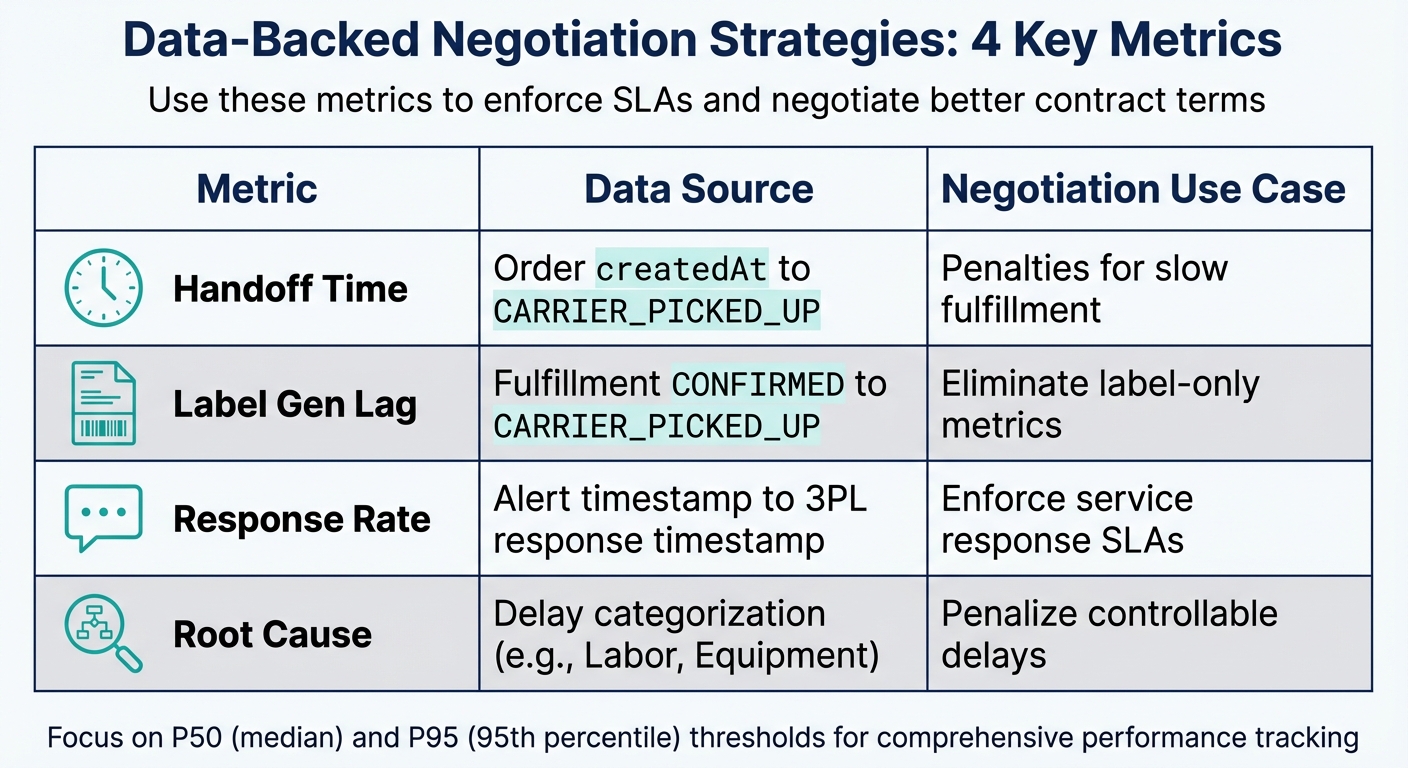
4 Key Metrics for Negotiating 3PL Contracts with Performance Data
With your performance data and documented SLA breaches in hand, you're ready to renegotiate your contract. Use this data to push for improved performance or adjust pricing. A smart strategy is to focus on percentile-based SLAs, specifically the P50 (median) and P95 (maximum acceptable) thresholds for handoff times. This ensures your contract accounts for both average performance and the worst-case scenarios.
Data-Backed Negotiation Strategies
When entering negotiations, focus on these four key metrics:
| Metric | Data Source | Negotiation Use Case |
|---|---|---|
| Handoff Time | Order createdAt to CARRIER_PICKED_UP |
Penalties for slow fulfillment |
| Label Gen Lag | Fulfillment CONFIRMED to CARRIER_PICKED_UP |
Eliminate label-only metrics |
| Response Rate | Alert timestamp to 3PL response timestamp | Enforce service response SLAs |
| Root Cause | Delay categorization (e.g., Labor, Equipment) | Penalize controllable delays |
These metrics provide a strong foundation for proposing performance-based pricing or penalties for SLA breaches. For example, if your data reveals frequent delays caused by issues under your 3PL's control - like staffing shortages or equipment breakdowns - you have a solid case for financial penalties.
Use quarterly business reviews to present "before and after" comparison reports. For instance, your 3PL might claim 95% same-day fulfillment based on label creation, but if your tracking data shows packages sitting idle in their warehouse for 21 hours, you have clear evidence to demand operational improvements or service credits.
If your provider is unwilling to address these issues, your data gives you the leverage to explore other options.
Compare Alternative Providers with RFP Tools
If your current provider doesn't improve, consider alternative options using competitive data. Tools like Forthmatch's RFP Quote Request (a $44 one-time fee) allow you to generate requests based on your actual order data. This tool provides side-by-side comparisons of regional providers, giving you actionable insights. Armed with this data, you can either push your current 3PL to match competitive pricing or confidently switch to a better-suited provider. This approach ensures you stay in control during negotiations.
Conclusion
Tracking data has the power to reshape your relationship with a 3PL provider. Instead of relying on guesswork or subjective frustration, you can use hard evidence to take control of the situation. For example, if 15% of orders fail to meet a 24-hour SLA or packages sit idle for 21 hours after label creation, those numbers speak volumes. They turn vague concerns into measurable problems that demand attention.
By continuously monitoring performance, you can uncover deeper issues like labor shortages, equipment breakdowns, or process bottlenecks. This insight allows you to create targeted improvement plans and hold providers accountable for their performance. The result? Real, actionable progress.
When it’s time to renegotiate contracts, having performance data and documented SLA violations gives you a significant advantage. With this leverage, you can push for service credits, demand performance-based pricing and transparent fee structures, or use RFP tools to compare other providers who may better meet your needs based on your actual order volume and regional requirements. In short, decisions are guided by facts, not assumptions.
Automated tools like Forthmatch make this process even easier. Starting at $19/month (with a 14-day free trial), Forthmatch can handle everything from flagging SLA violations to generating detailed comparison reports. These tools help you secure better contract terms, improve your 3PL’s performance, and reduce fulfillment headaches for your customers. When you control the data, you control the partnership.
FAQs
What is Forthmatch?
Forthmatch is a Shopify app designed to help merchants keep a close eye on their 3PL's (third-party logistics) fulfillment performance. It monitors shipping speeds, identifies SLA (service level agreement) violations, and pinpoints the reasons behind delays. With this information, merchants can hold their logistics partners accountable and create detailed, evidence-based reports to support contract negotiations. By transforming vague worries about delays into clear, actionable insights, Forthmatch empowers businesses to streamline their operations and address performance issues effectively.
How does it work?
Forthmatch works seamlessly with Shopify to keep tabs on your 3PL's performance. By analyzing up to 90 days of order history, it tracks key timestamps like "Order Created" and "Fulfillment" to determine shipping speeds. You can set SLA targets, such as ensuring orders ship within 24 hours, and the app will automatically flag any violations.
Beyond that, it categorizes delays, monitors alerts sent to your 3PL, and creates detailed reports. These reports can be invaluable for performance reviews or when it's time to negotiate contracts.
What does it cost?
Forthmatch offers a mix of subscription and pay-per-use options. Here's the breakdown:
- Performance Insights: $19/month, with a 14-day free trial included.
- Accountability Sessions: $89 per session.
- RFP Quote Requests: $44 each.
While there's no free plan, the 14-day trial for Performance Insights lets you explore all features without any risk.
Does it work with my 3PL?
Yes, Forthmatch is compatible with any 3PL or fulfillment center that handles orders via Shopify. It relies on Shopify's built-in order timestamps, which means there's no need for a custom integration with your 3PL's software.
Can I alert my 3PL about delays?
Yes, you can send one-click email alerts to your 3PL whenever an order breaches the SLA. The app keeps track of all alerts sent and logs whether the provider responded, giving you a clear record of their responsiveness.
What are 'Accountability Sessions'?
Accountability Sessions are a paid service designed to help you assess how well your third-party logistics (3PL) provider is performing. Here's how it works: you set a baseline for evaluation, track progress over a period of 2 to 4 weeks, and then receive a detailed PDF report. This report highlights the results before and after the session, giving you a clear picture of any changes.
This type of analysis can be particularly useful for quarterly performance reviews or when you're negotiating improved terms for your contract. It’s a practical way to ensure your 3PL is meeting expectations and delivering value.
![Thumbnail for: Best 3PL Providers for DTC Brands 2026 [Top 10 Compared]](https://assets.seobotai.com/cdn-cgi/image/quality=75,w=1536,h=1024/forthmatch.io/6849d5455559d477e753a23a-1749674972465.jpg)