Handling Shopify order fulfillment manually? It’s time to automate. If you're processing 100+ orders monthly, 3PL providers like ShipBob, ShipHero, and ShipMonk can save you time and money while improving delivery speed. Use a 3PL compatibility checker to see which provider aligns with your specific SKU count and shipping zones. Here's how they stack up:
- ShipBob: Best for fast-growing brands needing global reach. Offers 60+ warehouses, 2-day delivery, and straightforward 3PL pricing starting at $5/order.
- ShipHero: Ideal for high-volume merchants and Shopify Plus users. Combines fulfillment services and advanced warehouse software for $2.25+ per order or $1,995/month for WMS.
- ShipMonk: Perfect for small-to-mid-sized businesses and subscription boxes. No order minimums, with pick-and-pack fees from $3 to $5/item.
Quick Comparison
| Feature | ShipBob | ShipHero | ShipMonk |
|---|---|---|---|
| Best For | High-volume DTC brands | Shopify Plus merchants | Small-to-mid-sized brands |
| Warehouse Network | 60+ locations globally | 8 U.S./Canada facilities | 12 global centers |
| Order Minimums | 300+ orders/month suggested | $250/month minimum | None |
| Pick & Pack Pricing | $5/order + storage | $2.25+ per order | $3-$5/item |
| Order Accuracy | 99.95% | 99.9% | 99.99% |
| Delivery Speed (U.S.) | 2.3 days | 2.9 days | Not specified |
Each provider caters to specific needs - whether it’s scaling globally, managing complex operations, or keeping costs low. Read on for a detailed breakdown of their features, pricing, and use cases.
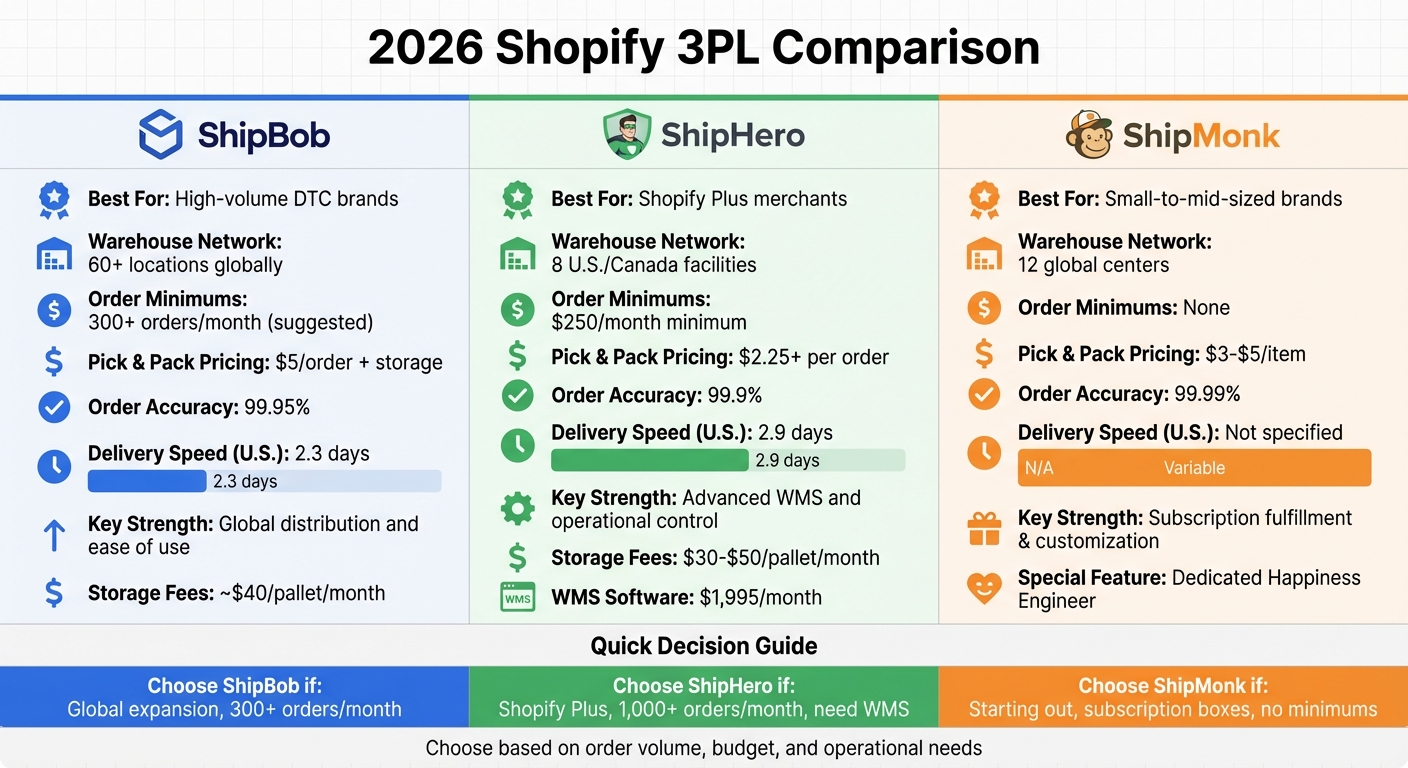
ShipBob vs ShipHero vs ShipMonk: 3PL Comparison for Shopify Stores 2026
Top Shopify 3rd Party Logistics Apps

sbb-itb-eb0f906
ShipBob: High-Volume Fulfillment Option
ShipBob operates over 50 fulfillment centers across the U.S., Canada, U.K., Australia, and Europe. This extensive network makes it a strong contender for Shopify merchants handling 300+ orders per month who want to expand quickly without dealing with in-house vs. outsourced fulfillment. With an impressive 99.95% order accuracy rate and an average delivery time of 2.3 days within the U.S., ShipBob offers reliability and speed.
ShipBob's Shopify Integration Features
ShipBob provides a native Shopify app with a one-click setup, ensuring seamless integration. It syncs orders and inventory in real-time, automatically routing orders to the nearest fulfillment center to reduce transit times. The unified dashboard allows merchants to monitor stock levels in real time, helping to prevent overselling. Merchants can also split inventory across multiple warehouses, improving efficiency and cutting costs by up to 35%. Additionally, ShipBob integrates with other platforms like Amazon, Walmart, and TikTok Shop.
One standout feature is ShipBob’s 2-day delivery badge for Shopify pages, which has reportedly reduced cart abandonment rates by up to 40%. While the platform offers custom packaging and inserts, some users find these options less flexible. These capabilities make ShipBob a strong choice for brands experiencing rapid growth.
When to Use ShipBob
ShipBob is a great fit for direct-to-consumer brands aiming for fast international expansion without investing in their own warehouse infrastructure. It’s particularly useful during seasonal demand spikes, as it eliminates the need for manual packing and carrier management. High-volume merchants often benefit from a dedicated account representative to help with scaling and troubleshooting.
That said, while ShipBob provides many advantages, it does come with specific pricing considerations and support challenges.
ShipBob Performance Data and Drawbacks
ShipBob’s pricing structure includes $0.20 for each additional item in an order after the first, about $40 per pallet per month for storage, and receiving fees starting at $35 per hour (increasing to $45 per hour after the first two hours). Onboarding costs typically run around $975, though a free self-service option may be available. Returns processing costs $3.00 per item, with average fulfillment costs landing at about $5.00 per order, plus storage fees. These details are crucial for evaluating whether ShipBob aligns with your high-volume and international expansion goals.
However, some merchants have expressed concerns about customer support. As Catherine G. shared on G2:
There is a lack of support beyond pointing in the direction of ShipBob's user manuals. I wish they would offer more personal support.
Additionally, reviews mention occasional issues with accountability for picking errors. It’s a good idea to request a detailed quote to uncover any hidden fees, particularly for specialized handling or custom packaging.
ShipHero: Warehouse Management for Complex Operations
ShipHero offers a combination of warehouse management software and fulfillment services, making it a go-to solution for many Shopify Plus merchants. Impressively, it supports over 10% of Shopify Plus stores worldwide and holds Shopify+ partner certification. With a stellar order accuracy rate of 99.9% and an average U.S. delivery time of just 2.9 days, ShipHero gives merchants the tools to maintain control over their operations while staying highly competitive.
ShipHero's Shopify Integration Features
ShipHero integrates with Shopify in less than five minutes - no custom development needed. Its standout features include AI Path Optimization, which reduces warehouse walking time by up to 30%, and Smart Batching, designed to increase pick density. Another innovation is the Tap-to-Pack hardware controller, an industrial-grade device with programmable buttons that eliminates the need for keyboards and mice at packing stations. This reduces on-screen interactions by 90%, streamlining packing workflows for merchants managing high order volumes.
The platform also includes Rate Shop Plus, which compares live carrier rates to pick the most cost-effective option for each shipment. Smart Order Merging combines multiple orders from the same customer into a single shipment, helping merchants save on shipping and packaging costs. For those managing multiple Shopify storefronts, ShipHero’s multi-store support consolidates everything into one dashboard.
Additional features like lot tracking, dynamic slotting, and customizable automation rules for order routing (based on SKUs, tags, or order value) add flexibility. ShipHero also integrates with other sales channels, such as Amazon and TikTok Shop, expanding its functionality beyond Shopify.
These capabilities make ShipHero particularly appealing for merchants with high-volume, complex operations.
When to Use ShipHero
ShipHero is ideal for Shopify Plus merchants processing over 1,000 orders per month who require advanced inventory control. It’s especially useful for businesses managing their own warehouses, as the warehouse management software starts at $1,995 per month. The platform shines when handling intricate product lines that might require lot tracking, custom workflows, or white-label fulfillment.
For example, Tidalwave, a 3PL provider, used ShipHero to scale to over 100,000 Shopify orders per month, enabling a single packer to process more than 1,000 orders daily.
Zaid Shahatit, Co-founder of 247 Fulfillment, summed it up well:
I describe ShipHero as the brains of our operation. If you're focused on scaling operations, then you need to make the jump and make the investment in your software.
ShipHero Performance Data and Drawbacks
ShipHero’s pricing includes $2.25 for the first item in an order and $0.25 for each additional item, with storage fees ranging from $30 to $50 per pallet monthly. There’s also a typical monthly minimum of $250+. Setup time is 2–4 weeks, slightly longer than ShipBob’s 1–2 week timeline, due to ShipHero’s higher level of customization.
The platform receives solid reviews: 4.3/5 on the Shopify App Store (115 reviews), 4.5/5 on Trustpilot (608 reviews), and 4.4/5 on G2 (181 reviews). Merchants appreciate its technical support and intuitive interface, which simplifies staff training. However, some users have noted that ShipHero’s support tends to be more technical and less hands-on compared to competitors. Additionally, its international warehouse network is smaller than ShipBob’s 50+ locations. The initial investment in AI-driven tools and hardware, along with the need for skilled personnel to manage the system, can be challenging for smaller businesses.
ShipMonk: Affordable Option for Small to Mid-Sized Brands
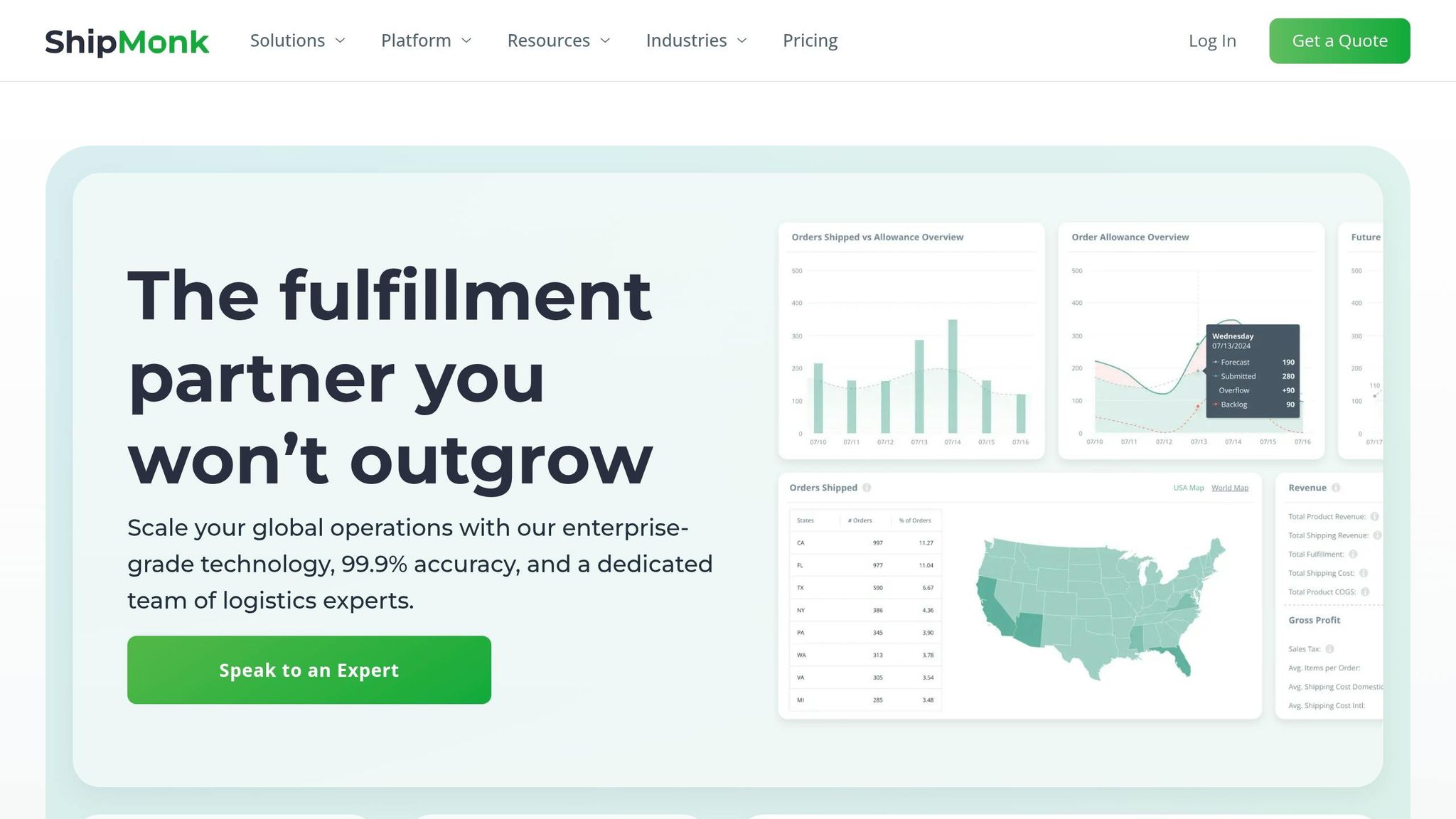
ShipMonk is a solid choice for smaller or seasonal Shopify merchants looking for dependable fulfillment without high order minimums or complicated requirements. With an estimated annual revenue of $225 million and a network of over 12 fulfillment centers worldwide, ShipMonk is designed to support startups and growing businesses. The company employs more than 2,000 team members and integrates with 66+ platforms, making it a versatile option for brands on the rise.
ShipMonk's Shopify Integration Features
ShipMonk makes fulfillment easy for smaller brands with its free-to-install Shopify app, which doesn’t require merchants to meet minimum order thresholds. Its proprietary software offers real-time inventory tracking and automated order management across multiple sales channels, ensuring smooth operations.
The pricing structure is transparent, featuring pick-and-pack fees between $3 and $5 per item, with an on-site calculator to help merchants estimate costs. Additionally, ShipMonk provides discounted shipping rates through its established carrier network, helping businesses save on logistics. The platform also stands out with its specialized services, including subscription box fulfillment, kitting, and bundling. Merchants are supported by a dedicated Happiness Engineer, who assists with onboarding and day-to-day operations.
These features make ShipMonk a practical option for brands operating with lean resources.
When to Use ShipMonk
ShipMonk is a great fit for merchants processing fewer than 400 orders per month or those working with limited fulfillment budgets. Its lack of order minimums is ideal for startups testing their product-market fit or seasonal businesses with fluctuating sales volumes. Brands selling subscription boxes, product bundles, or items requiring custom packaging will also benefit from ShipMonk’s kitting and bundling services.
With a global fulfillment network, ShipMonk enables small brands to expand internationally without the hassle of managing multiple warehouses. Merchants can use the pricing calculator to compare costs and request detailed breakdowns of additional services.
ShipMonk Performance Data and Drawbacks
ShipMonk has earned a 9.1/10 rating from 97 reviews on Taranker, with users highlighting its smooth onboarding process, knowledgeable account managers, and intuitive inventory management tools. However, some merchants have reported inconsistent customer service, difficulties with account closure and inventory retrieval, and occasional hidden costs in the pricing model, which may require closer monitoring.
While it doesn’t offer the advanced tools found in enterprise-level solutions, ShipMonk provides a simple and budget-friendly option for small to mid-sized brands. It’s especially appealing to businesses that prioritize affordability and ease of use over high-volume or complex fulfillment capabilities.
ShipBob vs. ShipHero vs. ShipMonk: Side-by-Side Comparison
When selecting a 3PL provider, it’s essential to consider your order volume, operational requirements, and business size. Each of these providers - ShipBob, ShipHero, and ShipMonk - caters to different segments of Shopify merchants with distinct strengths and pricing models.
| Feature | ShipBob | ShipHero | ShipMonk |
|---|---|---|---|
| Best For | Fast-growing DTC brands | High-volume/Shopify Plus merchants | Subscription boxes and small-to-mid brands |
| Warehouse Network | 60+ global locations | 8 North American facilities + partners | 12 global fulfillment centers |
| Order Minimums | Recommended 300+ orders/month | Typically $250.00/month minimum | No order minimums |
| Pick & Pack Pricing | $5.00 per order + storage | Starting at $2.25 for the first item, $0.25 for each additional item | $3.00 to $5.00 per pick |
| Order Accuracy | 99.95% | 99.9% | 99.99% |
| Average US Delivery | 2.3 days | 2.9 days | Not specified |
| Key Strength | Global distribution and ease of use | Advanced Warehouse Management System (WMS) and operational control | High-touch customization and subscription fulfillment |
Each provider offers unique advantages that impact your ability to scale, manage costs, and meet customer expectations. Let’s break it down further:
ShipBob is ideal for businesses focused on global reach, thanks to its 60+ warehouse locations worldwide. It simplifies international shipping and automates inventory management for growing DTC brands. Pricing typically includes $5.00 per order and storage fees of about $40.00 per pallet monthly.
ShipHero stands out for its dual offering: fulfillment services and a standalone Warehouse Management System (WMS). The WMS can cut warehouse expenses by over 35% and boost picking efficiency by up to three times. While fulfillment requires a $250.00 monthly minimum, its WMS software starts at $1,995.00 per month, catering to brands managing their own warehouses.
ShipMonk is a go-to for subscription boxes and small-to-medium businesses. Its standout features include dedicated Happiness Engineers and tailored services like kitting, bundling, and subscription fulfillment - all without order minimums. Pick-and-pack fees range between $3.00 and $5.00 per item, and volume discounts are available.
Understanding these differences will help you match your needs to the right 3PL provider. Whether you prioritize global shipping, advanced warehouse tools, or high-touch customization, the right choice depends on your budget, order volume, and automation goals.
How to Choose the Right 3PL Integration for Your Shopify Store
When selecting a 3PL provider for your Shopify store, it's essential to weigh factors like budget, order volume, and automation needs. These considerations can help you manage shipping costs, meet delivery expectations, and scale your business effectively.
Choosing by Budget
Your annual fulfillment budget plays a key role in picking the right 3PL provider:
- Budgets under $60,000 per year: Providers like ShipBob and ShipMonk are great options. They offer transparent pricing, with per-order fees typically ranging from $3.00 to $5.00, and are ideal if you're processing 300+ orders per month.
- Budgets between $60,000 and $150,000 per year: ShipBob and ShipMonk remain strong contenders, but ShipHero may also be worth considering if you need advanced warehouse management features. Be sure to account for additional costs like storage fees (around $0.40 per cubic foot), receiving fees, and monthly minimums that generally fall between $250 and $500.
- Budgets above $150,000 per year: High-volume businesses often lean toward ShipHero for its enterprise-level inventory management and AI-driven picking system. These features have been shown to reduce errors by 99% and triple picking efficiency. At this level, operational improvements often outweigh concerns about monthly minimums.
After narrowing your options by budget, consider your order volume and product type to refine your decision further.
Choosing by Order Volume and Product Type
Order volume and the nature of your products are equally important:
- Fewer than 300 orders per month: Avoid providers with strict minimums.
- 300 to 1,000 orders per month: Mid-tier providers like ShipBob or ShipMonk excel here, offering distributed inventory and bulk shipping discounts.
- 1,000+ orders per month: Providers like ShipHero shine, offering robust multi-channel synchronization with platforms like Shopify, Amazon, and TikTok.
Product specifics also matter. Lightweight items under 5 lbs can be shipped efficiently by any of these providers. However, heavier or bulkier products (e.g., furniture, gym equipment, or large electronics) may require specialized handling. For subscription boxes or products needing kitting and bundling, ShipMonk is often the best fit.
Choosing by Integration and Automation Needs
Evaluating top 3PL tech integrations and automation capabilities is crucial for streamlining operations:
- All three providers - ShipBob, ShipMonk, and ShipHero - offer native Shopify apps that automate updates, reducing manual work.
- ShipHero, which supports over 10% of Shopify Plus stores worldwide, provides excellent multi-channel capabilities, making it a strong choice for sellers operating across multiple platforms.
- ShipBob stands out with its ability to distribute inventory across 60+ warehouses, enabling 2-day ground shipping to 95% of the U.S..
When evaluating providers, check their daily cutoff times for same-day shipping, as missing a 4 p.m. ET deadline, for instance, can lead to delays. If custom workflows are part of your operations, test the provider's API capabilities. Notably, 74% of shippers report they'd switch 3PL providers for better AI features, highlighting the growing demand for advanced automation.
Conclusion
Deciding between ShipBob, ShipHero, and ShipMonk comes down to your business needs, order volume, and operational requirements. In this comparison, we looked at factors like integration capabilities, automation, scalability, and pricing to help identify the right 3PL for different merchant profiles. Each provider brings its own strengths, tailored to specific business demands.
ShipBob stands out as a solid choice for fast-growing direct-to-consumer brands. With a network of over 60 fulfillment centers worldwide, it ensures quick delivery times, averaging just 2.3 days in the U.S. It's particularly appealing to merchants handling 300+ orders per month, offering a streamlined fulfillment process with predictable costs of about $5 per order.
On the other hand, ShipHero is ideal for high-volume, multi-channel operations, especially for Shopify Plus merchants. It supports over 10% of Shopify Plus stores globally, helping reduce warehouse costs by more than 35% and increasing picking efficiency by up to three times. With a monthly minimum starting at $250 and custom pricing, it caters to established brands with more complex needs.
For small to mid-sized brands, ShipMonk offers flexibility and customization, making it a strong option for businesses focused on subscription boxes, kitting, or niche marketplace sales. With no order minimums and pick fees ranging from $3.00 to $5.00, it’s a great fit for growing brands. However, it has faced criticism for hidden fees, reflected in its TrustScore of 3.1/5.
Evaluate your order volume, operational complexity, and budget carefully to select the 3PL that aligns with your business goals. Each of these providers offers unique advantages for different types of merchants.
FAQs
When should I switch from self-fulfillment to a 3PL?
When your order volume reaches a point where handling storage, packing, and shipping starts to feel overwhelming or expensive, it might be time to consider switching to a 3PL (third-party logistics provider). Some clear signs include dealing with increasingly complex logistics, needing quicker delivery times to meet customer expectations, or planning to expand into new markets. By outsourcing fulfillment, you can streamline operations, lower costs, and free up time to focus on scaling and growing your business.
What extra fees should I expect beyond pick-and-pack?
When using pick-and-pack services, you'll encounter additional fees beyond the basic service. Storage costs are typically calculated per cubic foot or pallet, while shipping charges depend on factors like carrier rates, delivery zones, and shipping speed. Returns processing also comes with its own fees.
Other expenses to watch for include handling oversized or hazardous items, custom packaging, labeling, and API integrations. It's essential to carefully review the fee structure. Variable costs, such as surcharges for expedited shipping or deliveries to remote areas, can add up quickly and significantly affect your overall expenses.
How do I know if a 3PL can handle my products?
To figure out if a 3PL is the right fit for your products, start by checking whether they have experience managing items similar to yours. This includes considering factors like size, weight, or any unique handling requirements. Take a close look at their technology - do their inventory systems and ecommerce integrations match what your business needs? Also, evaluate their warehouse locations and whether they can scale as your business grows. Lastly, make sure they comply with industry standards and offer specialized services, like cold storage or secure handling, that align with your specific product needs.