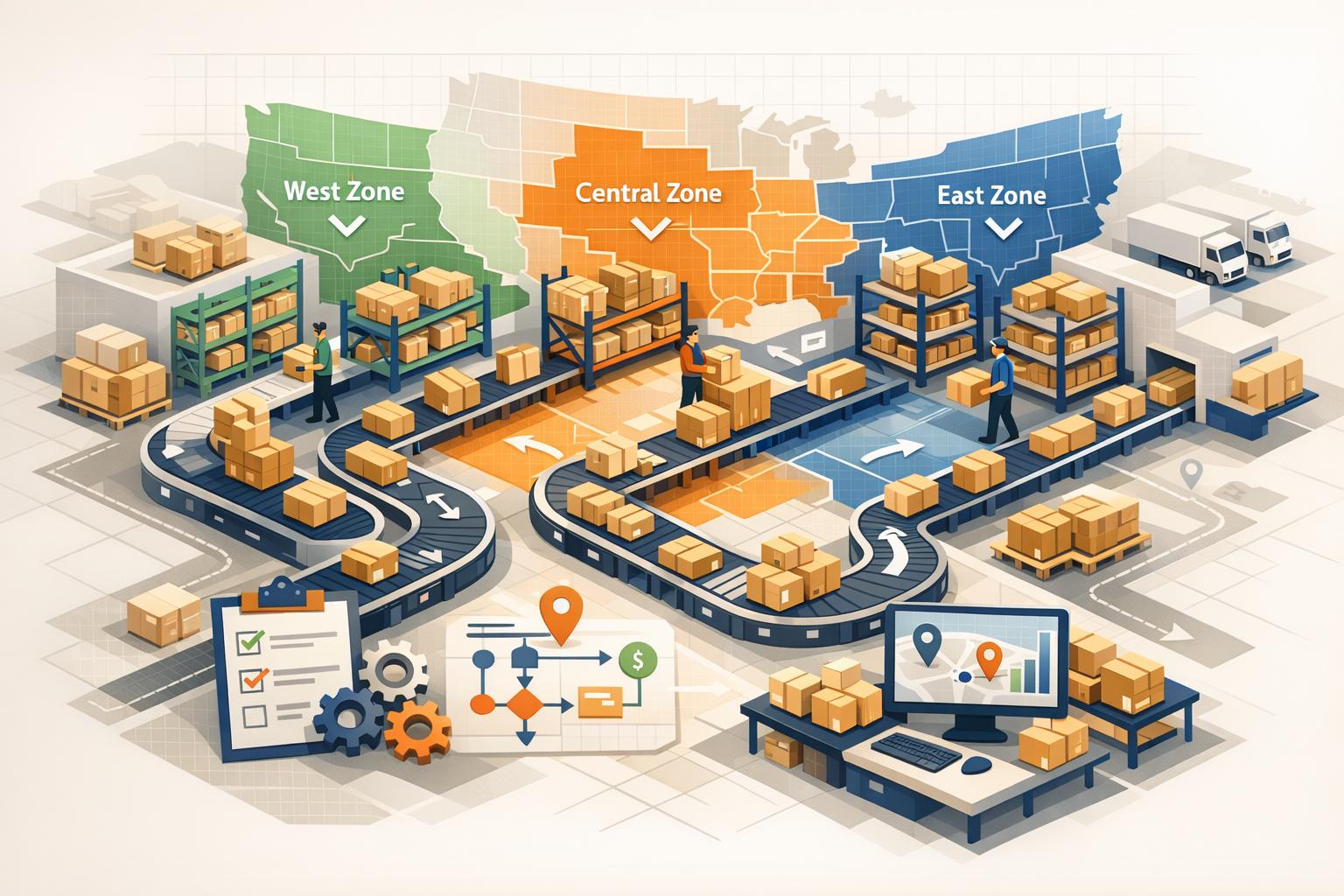
Finding the right 3PL partner in 2026 is critical for Shopify merchants managing B2B operations. Implementing a robust Shopify 3PL integration is essential for maintaining real-time inventory accuracy across these channels. The logistics landscape has shifted, with advanced AI-driven inventory management, robotic picking systems, and global warehouse networks leading the way. Using a 3PL compatibility checker can help businesses cut logistics costs by 20–35% while maintaining high compliance rates and avoiding costly chargebacks.
Here’s a quick summary of the top 3PL providers and their strengths:
- Buske Logistics: Tailored solutions for mid-market and enterprise clients, with deep expertise in regulated industries like Food & Beverage and Healthcare.
- DHL Supply Chain: A global powerhouse with over 1,600 warehouses in 50+ countries, ideal for international growth and cross-border logistics.
- GXO Logistics: Advanced automation and EDI capabilities for large-scale retail fulfillment and multi-location distribution.
- Ryder Supply Chain Solutions: Focused on B2B compliance and real-time visibility with robust technology integrations.
- GEODIS: Global operations with strong EDI and retail routing compliance, helping merchants expand internationally.
Quick Comparison
| Provider | Key Strengths | Best For | Technology Focus |
|---|---|---|---|
| Buske Logistics | Custom solutions, hybrid fulfillment | Regulated industries, mid-market | Sequencing, kitting, assembly |
| DHL Supply Chain | Global reach, express shipping | International scaling | AI, Green Logistics |
| GXO Logistics | Automation, high-volume operations | Retail fulfillment, scalability | Robotics, WMS integration |
| Ryder Supply Chain | Compliance, real-time visibility | Complex B2B operations | RyderShare platform, EDI |
| GEODIS | International logistics, retail focus | Global expansion | WMS, OMS, ERP |
Each provider offers unique capabilities based on your business needs. Whether you’re scaling globally or managing strict retailer requirements, aligning with the right 3PL can streamline your operations and protect your bottom line.
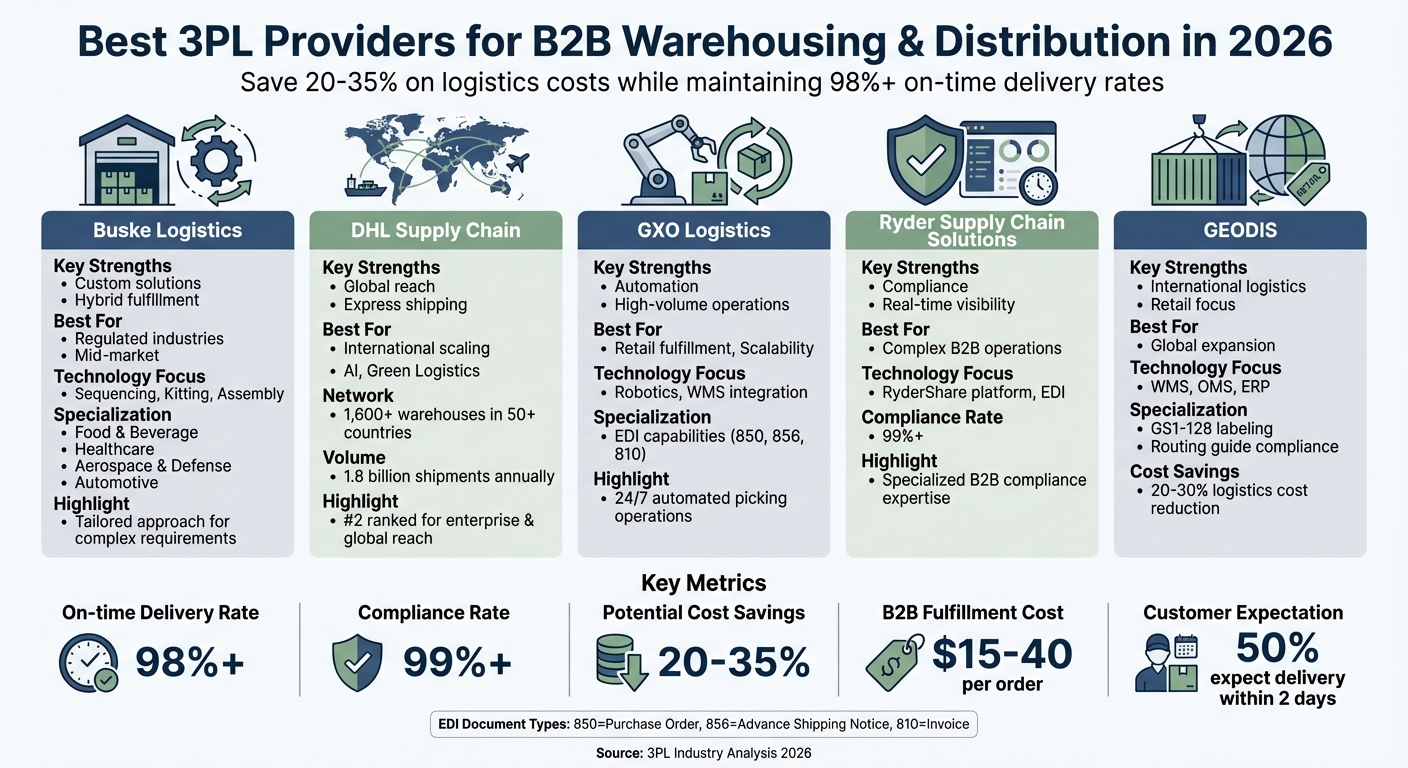
Top 5 3PL Providers for B2B Warehousing: Features and Strengths Comparison 2026
Choosing a 3PL: What Every Business Should Know
Beyond the video, using a 3PL selection checklist can help ensure you don't miss critical operational requirements during your search.
sbb-itb-eb0f906
1. Buske Logistics
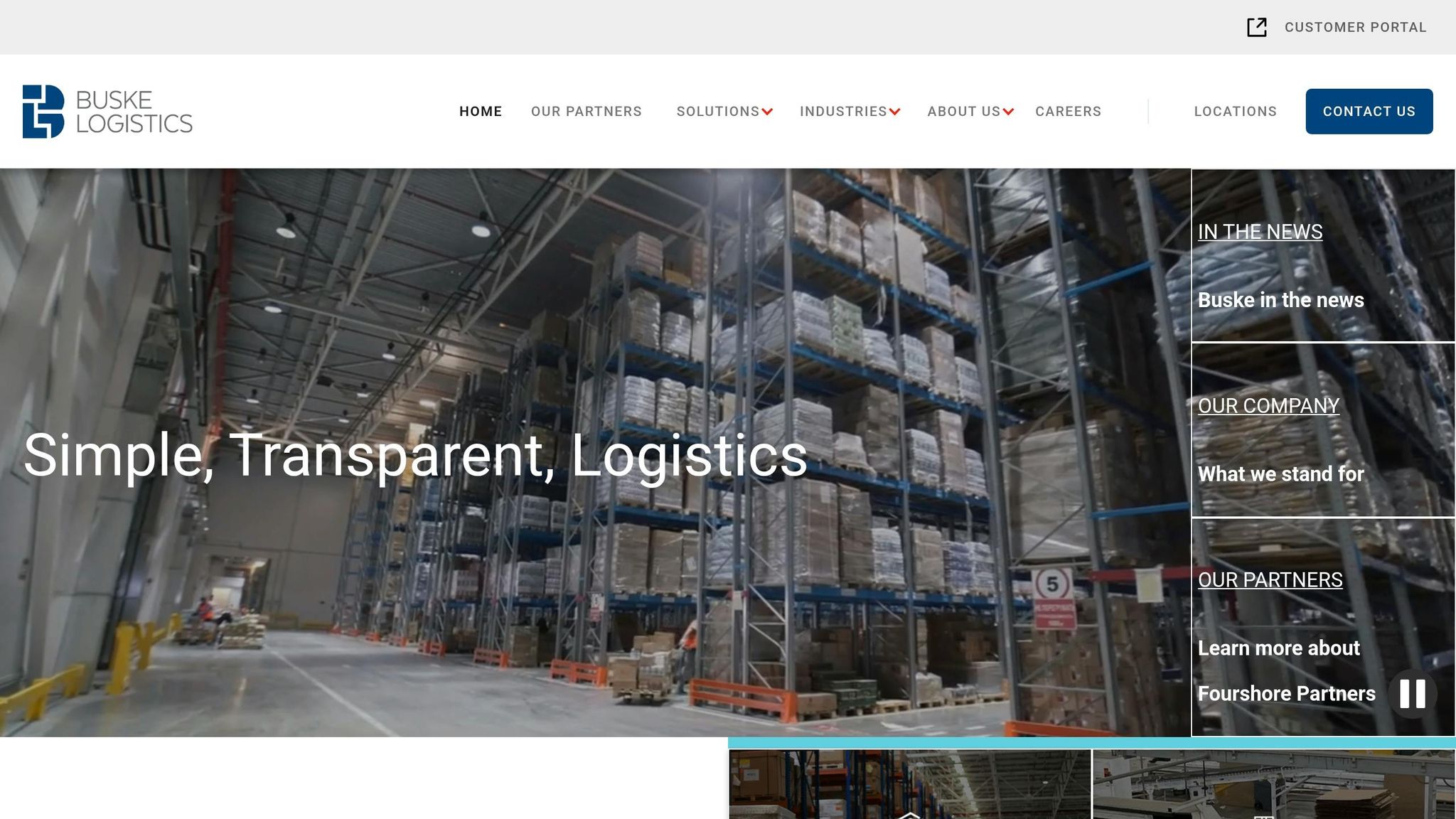
Buske Logistics focuses on providing tailored logistics solutions for mid-market and enterprise clients, setting itself apart from providers that rely on standardized processes. With its emphasis on customized approaches, Buske is an excellent option for Shopify merchants venturing into retail distribution or managing unique product lines.
Warehouse Network
Buske operates a network of 3PL fulfillment centers and warehouses that are strategically located to support both regional and national distribution. These facilities are positioned in major industrial hubs, allowing for efficient access to key markets while accommodating specialized handling needs.
Technology Integration
Buske integrates advanced 3PL tech integrations to streamline order management and inventory tracking across multiple channels. Their technology stack includes features like sequencing and value-added services, which are designed to seamlessly handle tasks such as kitting, assembly, and custom packaging - perfect for Shopify merchants with complex fulfillment requirements.
Specialization
Buske has deep expertise in industries like Food & Beverage, Aerospace & Defense, Automotive, Healthcare, Industrials, and Retailers/Distributors. For Shopify merchants operating in regulated sectors, this specialization is invaluable, as Buske is equipped to navigate compliance challenges and the intricate logistics these industries demand.
Scalability
Buske’s hybrid model supports both B2B and B2C fulfillment, allowing brands to manage wholesale pallet shipments alongside individual consumer orders. By consolidating these services under one provider, Shopify merchants can simplify their omnichannel strategies and transition from direct-to-consumer sales to large-scale retail partnerships without juggling multiple vendors. This specialized approach offers an alternative to the more standardized operations of larger logistics providers discussed later in this article.
2. DHL Supply Chain
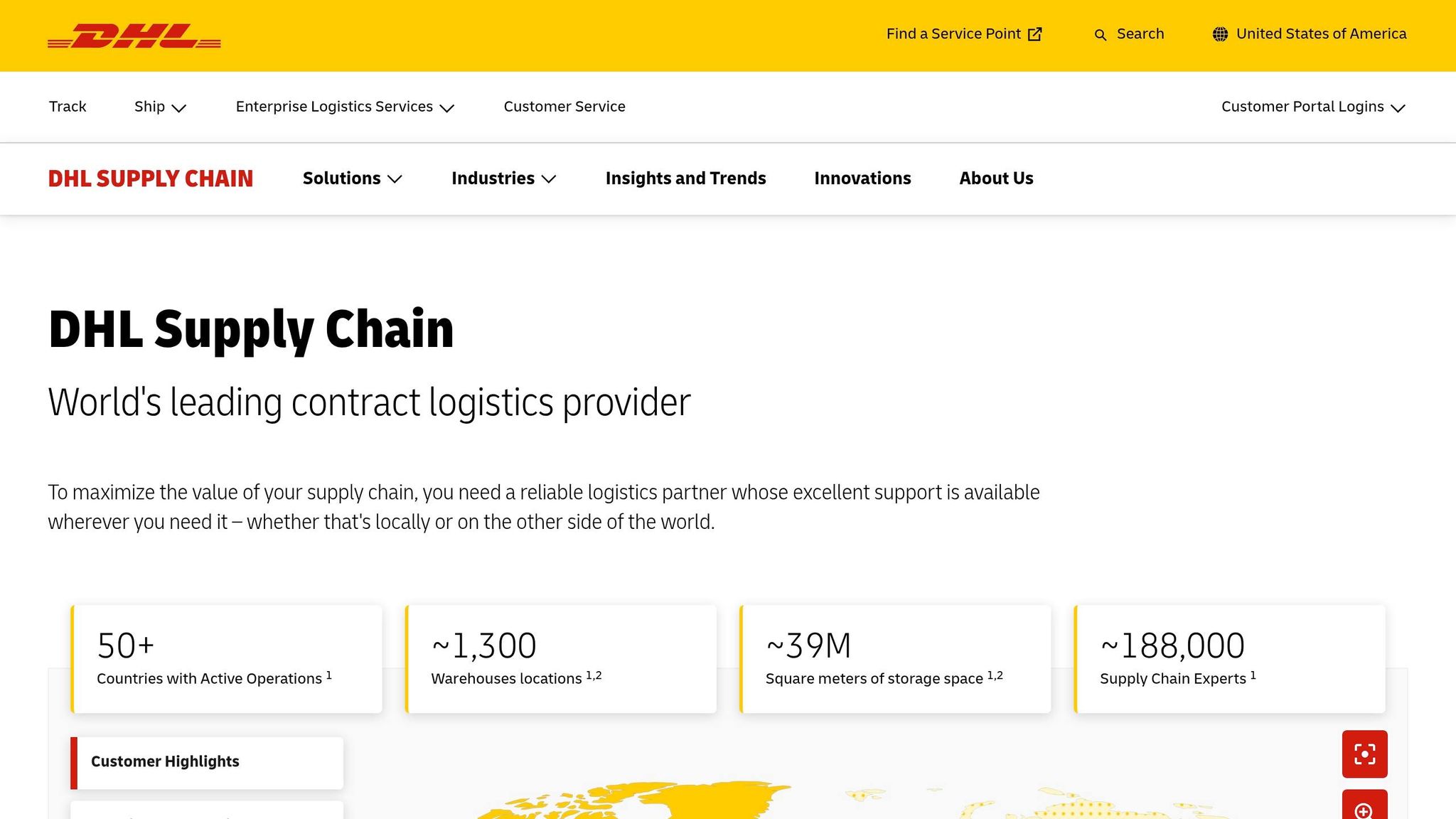
DHL Supply Chain stands out as a global logistics powerhouse, operating in over 220 countries and territories. For Shopify merchants eyeing international growth, DHL's expansive reach and infrastructure are hard to ignore. With a workforce of more than 595,000 and an annual shipment volume of approximately 1.8 billion, DHL delivers enterprise-level solutions for B2B warehousing and distribution.
Warehouse Network
DHL operates 1,600+ warehouses across 50+ countries, offering Shopify merchants the flexibility to explore international markets without committing to permanent facilities. These strategically located warehouses are optimized for time-sensitive deliveries, making them ideal for express and international shipping needs.
Technology Integration
DHL leverages advanced analytics to enhance supply chain efficiency and employs 3PL software for smooth order management. Their systems integrate seamlessly with platforms like the Shopify Fulfillment Network . The company has heavily invested in automation and AI-driven tools, a move aligned with industry trends - 74% of shippers say they would switch providers for better AI capabilities. Additionally, DHL supports Green Logistics initiatives, catering to merchants prioritizing sustainable supply chain practices. This blend of technology and scale ensures consistent performance on a global level.
Specialization
As a transportation-focused 3PL, DHL excels in moving inventory across global markets via truck, air, and sea . This expertise is particularly valuable for Shopify merchants navigating the complexities of cross-border e-commerce, including brokerage fees, customs duties, and import/export taxes . DHL handles shipments of all sizes, from less-than-truckload (LTL) for smaller batches to full-truckload freight for large-scale inventory needs . Ranked #2 for enterprise and global reach among top e-commerce 3PLs in 2026, DHL's operational maturity and international capabilities are widely recognized.
Scalability
DHL's infrastructure is built to scale with brands as they grow from regional to global markets. Their ability to manage diverse shipping options - from ground deliveries to express and international freight - helps merchants meet rising customer demands, especially as nearly 50% of consumers now expect delivery within two days . While their services come with premium pricing, they are well-suited for mid-market and enterprise-level brands .
Next, we’ll take a closer look at GXO Logistics to compare its strengths within the industry.
3. GXO Logistics
GXO Logistics stands out as a global leader in logistics, with a vast network of warehouses across North America, Europe, and other regions. For Shopify merchants managing B2B operations, GXO offers enterprise-level infrastructure that supports brands requiring global coordination and consistent processes across multiple locations.
Warehouse Network
GXO's network includes strategically located warehouses optimized for handling large-scale retail fulfillment. This setup allows Shopify merchants to position inventory closer to key B2B customers, cutting down on transit times and shipping expenses. With the flexibility to manage both regional and cross-border logistics, GXO is an excellent option for brands looking to expand their wholesale operations.
Technology Integration
GXO leverages state-of-the-art warehouse automation, including robotics that operate 24/7 to efficiently pick and pack orders. This technology enables later order cutoffs while still meeting same-day shipping deadlines, a crucial benefit for B2B clients with tight delivery schedules. Additionally, GXO's Warehouse Management System (WMS) integrates seamlessly with Shopify through approved 3PL apps. Merchants can oversee inventory, track orders, and manage fulfillment - all from a single platform, eliminating the hassle of juggling multiple tools.
Specialization
GXO is a leader in B2B retail fulfillment, offering advanced EDI (Electronic Data Interchange) capabilities that streamline critical documents like purchase orders (850), advance shipping notices (856), and invoices (810). For Shopify merchants working with retail partners, this automation bridges the gap between online storefronts and vendor systems, providing real-time inventory insights and aging reports. By reducing manual data entry, GXO minimizes errors and ensures smoother B2B transactions.
Scalability
Built for enterprise-level operations, GXO's infrastructure handles high-volume orders and supports multi-location distribution effortlessly. Their systems allow businesses to scale from regional operations to international markets without the need for merchants to invest in their own warehousing. This makes GXO an ideal partner for Shopify businesses shifting from direct-to-consumer models to wholesale or hybrid approaches.
Up next, we’ll explore Ryder Supply Chain Solutions and its role in the B2B logistics landscape.
4. Ryder Supply Chain Solutions
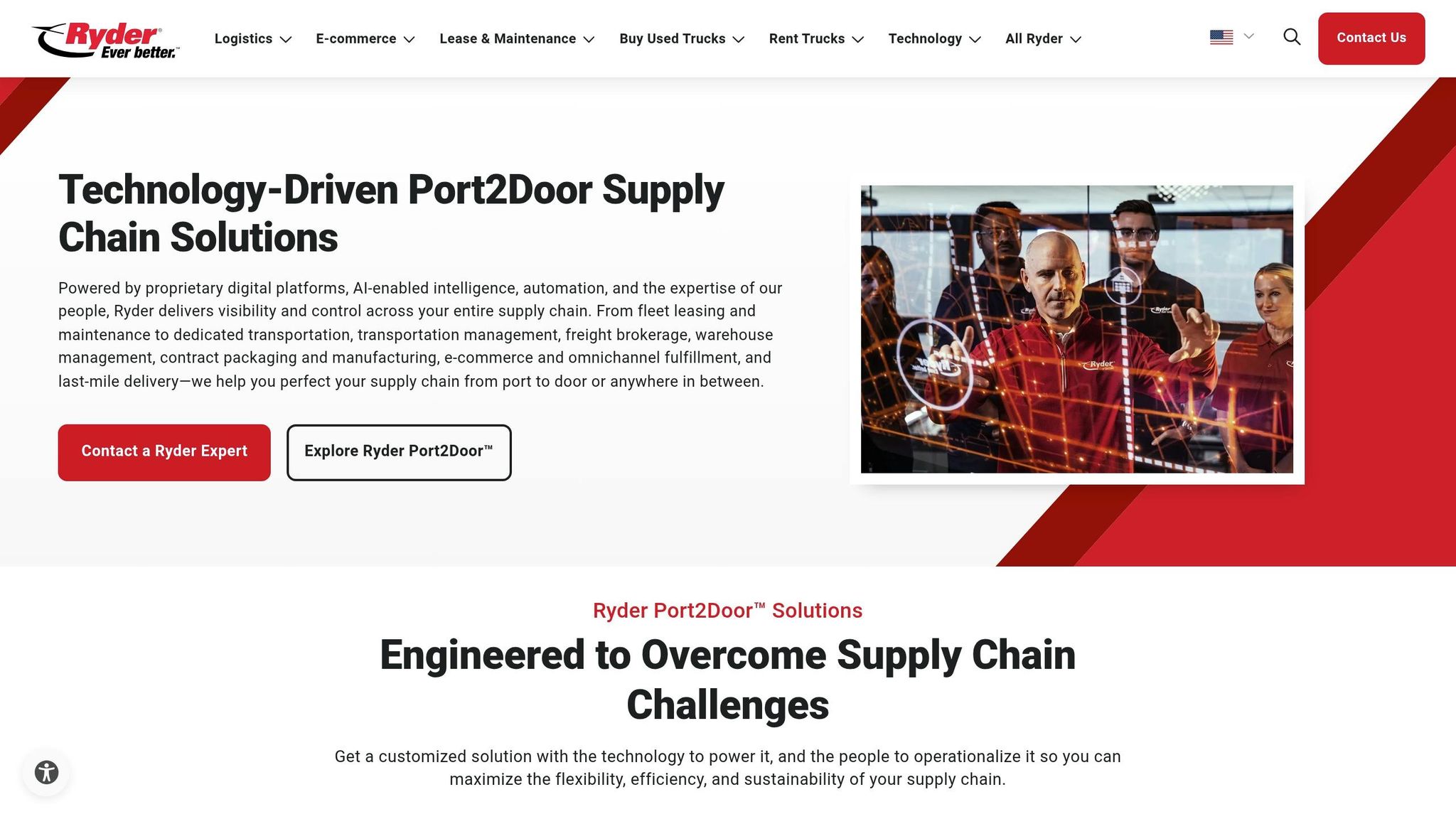
Ryder Supply Chain Solutions provides a robust logistics framework for B2B warehousing and distribution. They blend their traditional supply chain expertise with e-commerce capabilities tailored for Shopify merchants.
Technology Integration
Ryder uses its RyderShare platform to deliver real-time visibility across the supply chain. By integrating advanced Warehouse Management Systems (WMS) and Transportation Management Systems (TMS) with Shopify, they automate processes like order flow and inventory updates. This tech-driven approach ensures seamless operations and supports compliance-specific needs.
Specialization
Ryder specializes in meeting complex B2B compliance requirements. They facilitate essential EDI (Electronic Data Interchange) integration for documents like 850 (Purchase Order), 856 (Advance Shipping Notice), and 810 (Invoice). This guarantees smooth and standardized electronic communication for all transactions.
Scalability
Ryder's systems are built to handle the intricate demands of B2B fulfillment. From managing retail routing guides to meeting tight delivery schedules, their solutions are equipped to scale with business needs. Next, we’ll take a closer look at GEODIS and its approach to global B2B logistics.
5. GEODIS
Building on Ryder's specialized approach, GEODIS offers a comprehensive global solution tailored for B2B logistics. As a French leader in global logistics, GEODIS focuses on enterprise-level operations, providing services in warehousing, distribution, and transportation management across multiple continents.
Warehouse Network
GEODIS operates an extensive network of warehouses designed to support B2B logistics. These facilities handle inventory tracking, order fulfillment, and efficient space management. This global reach enables Shopify merchants to expand internationally while maintaining consistent service quality.
Technology Integration
GEODIS employs advanced systems like Warehouse Management Systems (WMS), Order Management Systems (OMS), and Enterprise Resource Planning (ERP) to integrate seamlessly with Shopify. Orders placed through Shopify are automatically processed within GEODIS's system, where teams handle picking, packing, and labeling with precision. Their automation capabilities, including robotics and automated equipment, allow for round-the-clock picking operations. This robust tech infrastructure supports their specialized compliance services.
Specialization
GEODIS excels in meeting retailer routing guide requirements through EDI integration. They also offer tailored services like floor-loaded truck handling, custom pallet configurations, and GS1-128 labeling - key features for Shopify merchants working with major retailers. By partnering with GEODIS, Shopify store owners can potentially cut logistics costs by 20-30% while maintaining top-tier service levels.
Comparison: Strengths and Limitations
This section dives into the strengths and trade-offs of different logistics providers, helping Shopify merchants make informed decisions.
Buske Logistics stands out for its tailored fulfillment solutions across industries like Food & Beverage, Automotive, and Healthcare. It offers specialized services like sequencing and kitting, which many asset-based providers don't. However, its global parcel reach is more limited compared to major transportation carriers.
DHL Supply Chain is a leader in international freight, with over 1,600 warehouses spread across 50+ countries. This makes it an excellent choice for Shopify merchants looking to expand globally. Its edge lies in managing international logistics efficiently with standardized processes.
GXO Logistics, Ryder Supply Chain Solutions, and GEODIS shine when it comes to handling large-scale operations and ensuring retail routing guide compliance rates above 99%. This can help Shopify merchants avoid chargebacks, which can cost up to 25% of an invoice's value. However, these providers often require significant upfront investments in software integrations and SKU management. This can reduce a merchant's direct control over shipping processes.
When choosing a logistics provider, merchants must balance cost efficiency with operational control. Asset-based providers like Buske offer stable pricing and high levels of customization because they own their warehouses and trucks. On the other hand, non-asset providers rely on partner networks to scale quickly but may offer less control over operations.
Top-tier B2B third-party logistics providers (3PLs) maintain on-time delivery rates above 98%, with potential cost savings of 20–35% on logistics. However, B2B retail fulfillment can be pricey, costing $15–$40 per order due to strict compliance requirements, pallet-level handling, and EDI setup fees, which range from $500 to $2,500 per retailer. Shopify merchants need to weigh these costs against the potential savings and operational benefits when selecting a provider.
These insights can help Shopify merchants align their logistics strategies with their broader business goals.
Conclusion
Choosing the right 3PL provider for your Shopify store is all about understanding your specific operational needs. For merchants looking to expand internationally, DHL Supply Chain and GEODIS stand out with their vast networks spanning over 50 countries. On the other hand, if you're in specialized sectors like Food & Beverage or Healthcare, Buske Logistics offers tailored services, such as sequencing and kitting. For high-volume B2B operations and strict retail compliance, GXO Logistics and Ryder Supply Chain Solutions are reliable options, boasting delivery rates above 98% and compliance rates over 99%.
Scaling your Shopify business means aligning your logistics partner with your product type and market demands. While effective B2B fulfillment can come with additional fees, partnering with the right 3PL can lead to logistics cost savings of up to 20–35%. The trick lies in matching your provider's expertise - whether that's global reach, retail compliance, or industry-specific skills - with your operational goals.
Accountability is equally critical. With nearly 50% of customers expecting delivery in under two days, missed service level agreements (SLAs) can tarnish your brand's reputation. Tools like Forthmatch help Shopify merchants stay on top of their 3PL's performance by automatically tracking late shipments and pinpointing delays - no custom setup required.
"Your brand reputation is only as good as your 3PL's worst day. If they miss an SLA, your business absorbs the fallout." - Chris Pitocco, Shopify
To monitor your fulfillment performance, start using Forthmatch, a free tool built for Shopify merchants. Need to compare providers or renegotiate terms? The Accountability Session ($89) generates detailed, evidence-based reports, while the RFP Quote Request ($44) helps you secure competitive proposals. Visit Forthmatch to turn shipping challenges into actionable insights.
For more insights on optimizing your supply chain, explore our related resources. Check out our Global B2B Marketplaces & Surplus Liquidation guide or dive into cost-saving strategies in our Wholesale vs. Liquidation Negotiation Tactics article.
FAQs
Which 3PL is best for Shopify B2B retail compliance?
To stay ahead in 2026, the top third-party logistics (3PL) providers for Shopify B2B retail compliance will combine strategic locations, cutting-edge technology, and deep expertise in B2B logistics. Companies like Buske Logistics and Fulfill.com already stand out for their ability to meet compliance requirements, manage large-scale shipments, and navigate the complexities of supply chains.
When choosing a 3PL, prioritize providers that offer:
- Real-time inventory tracking to keep your stock levels accurate and transparent.
- Scalable solutions that can grow alongside your business demands.
- Geographic distribution to ensure faster delivery times and wider reach.
These features not only help streamline operations but also ensure you consistently meet industry standards without missing a beat.
What EDI documents are required for B2B shipping?
For B2B shipping, some commonly used EDI documents are the Advanced Shipping Notice (ASN), Purchase Order (PO), Invoice, and Bill of Lading (BOL). These documents allow businesses to exchange data electronically, simplifying and improving logistics processes.
How do I measure my 3PL’s SLA performance?
To gauge how well your 3PL provider is meeting their SLA commitments, focus on tracking key metrics. These include order accuracy, on-time delivery rates, inventory accuracy, and response times. Regularly reviewing performance reports and keeping an eye on trends can help ensure these metrics stay in line with what the SLA promises.
For example, high standards like a 98% on-time delivery rate and 99% order accuracy are strong indicators of dependable service. Leveraging real-time data and conducting audits can also help you spot potential issues early and ensure SLA compliance stays on track.