Security failures at third-party logistics (3PL) facilities are causing significant disruptions for Shopify merchants in 2026. Here's why this matters and what has changed:
- Key Risks: Breaches (cyber, physical, or operational) lead to lost inventory, customer data exposure, and delayed shipments.
- Customer Expectations: 50% of shoppers now demand two-day delivery, making delays or security lapses unacceptable.
- Rising Costs: A single breach can erase the 20–35% savings merchants typically gain from outsourcing logistics.
- New Threats: AI-powered cyberattacks, rapid warehouse expansions, and stricter regulations are exposing vulnerabilities.
- Impact on Trust: Security failures directly harm a merchant’s reputation, leading to customer churn and lost revenue.
To navigate these challenges, Shopify merchants must actively evaluate 3PL compatibility and monitor their partners’ physical security, cybersecurity, and compliance practices. Tools like real-time tracking systems and regular audits are critical for ensuring accountability and minimizing risks.
The Hidden Threat INSIDE Your Tools: How Digital Supply Chain Attacks Really Happen
sbb-itb-eb0f906
What Is 3PL Facility Security
3PL facility security involves multiple layers of protection designed to safeguard inventory, customer data, and order fulfillment processes against theft, cyber threats, and operational mishaps. For Shopify merchants, this means ensuring that the warehouses managing their products have the necessary systems in place to avoid losses that could hurt profits and customer satisfaction.
This type of security goes well beyond just locking doors. It includes physical protections like access controls and surveillance, cybersecurity measures to keep customer information safe during order processing, and operational controls to ensure accuracy and compliance in daily warehouse activities. Without these safeguards, merchants risk inventory shrinkage, data breaches, and fulfillment errors - all of which can directly affect their bottom line.
By understanding the core components of 3PL security, Shopify merchants can better evaluate whether their 3PL partner is truly equipped to protect their business or if they might be leaving themselves vulnerable to preventable risks. Let’s break down the key elements that define secure 3PL operations.
Physical Security Measures
The first layer of security focuses on physical protection, which uses access controls and surveillance to prevent unauthorized entry. Role-based access systems restrict entry to high-security areas, ensuring only authorized personnel can interact with valuable inventory. This is especially critical for Shopify merchants selling high-value products, as internal theft remains a considerable issue - retailers reported an 18% increase in shoplifting incidents in 2024 compared to the previous year.
Strong physical security measures include reinforced entry points, such as heavy-duty doors and high-mounted windows, to delay break-ins. Surveillance cameras deter theft and provide evidence in case of breaches, while proper lighting eliminates potential hiding spots. Alarm systems that can alert security teams immediately add another layer of protection.
Some facilities go even further by implementing specialized storage solutions for high-value items. These may include caged areas, weight-based verification systems, and role-based access to specific zones. Such measures address the issue of "phantom inventory", where discrepancies between physical stock and inventory records lead to overselling and customer dissatisfaction.
Cybersecurity in 3PL Operations
When a Shopify store connects to a 3PL's Warehouse Management System (WMS), sensitive customer data flows between systems continuously. This includes personal information, payment details, and order records, all of which must be protected using encryption and secure transmission protocols. A single cybersecurity breach could expose thousands of customer records, leading to compliance violations and loss of customer trust.
Reliable 3PL partners use multi-factor authentication (MFA) and Address Verification Services (AVS) to screen high-risk orders and reduce fraud. They also monitor systems in real-time to detect unusual activity quickly, ensuring smooth operations even when threats arise. This is particularly important as 74% of shippers say they would switch providers for better AI capabilities, often to address security gaps caused by staff shortages.
Compliance with data protection regulations, like GDPR for international orders, is another critical aspect of cybersecurity. 3PLs serving Shopify merchants must adhere to these standards to reduce legal risks when selling across borders. Additionally, Shopify 3PL integration for inventory management ensures that information flows safely between ERPs and providers ensures that information flows safely, avoiding vulnerabilities created by weak point-to-point connections.
These cybersecurity measures work hand-in-hand with operational controls to create a comprehensive security framework.
Operational Security and Compliance
While cybersecurity safeguards protect data, operational controls are essential for maintaining process integrity. This includes preventing "process drift", where staff deviate from standard operating procedures (SOPs) over time. Regular inspections of inventory, equipment, and workflows help identify and correct these deviations before they escalate into bigger issues. As Elise Dopson highlights in Shopify's warehouse audit guide:
"Warehouse audits are not punitive; they're an operational feedback loop that protects people and profit".
Inventory audits are especially important for identifying discrepancies early. A practical method involves selecting 10 high-moving SKUs and 5 problem SKUs regularly to compare physical counts with Inventory Management System (IMS) records. Variances usually fall into two categories: surplus inventory (caused by mixed SKUs or packing errors) or shortages (indicating theft, mislabeling, or unscanned shipments).
Safety compliance also plays a vital role in operational security. In 2023, the transportation and warehousing sector reported 930 fatalities, with a fatal injury rate of 12.9 per 100,000 full-time workers. Between 2018 and 2023, OSHA cited over 2,500 workplace violations in warehouse and last-mile delivery operations. For Shopify merchants, conducting regular operational audits not only protects assets but also prevents fulfillment errors that could harm customer trust. Daily inspections of machinery like forklifts and maintaining clear pedestrian lanes are not just safety measures - they also help avoid operational disruptions and liability issues that could bring fulfillment to a standstill.
What Changed in 2026: New Threats and Industry Shifts
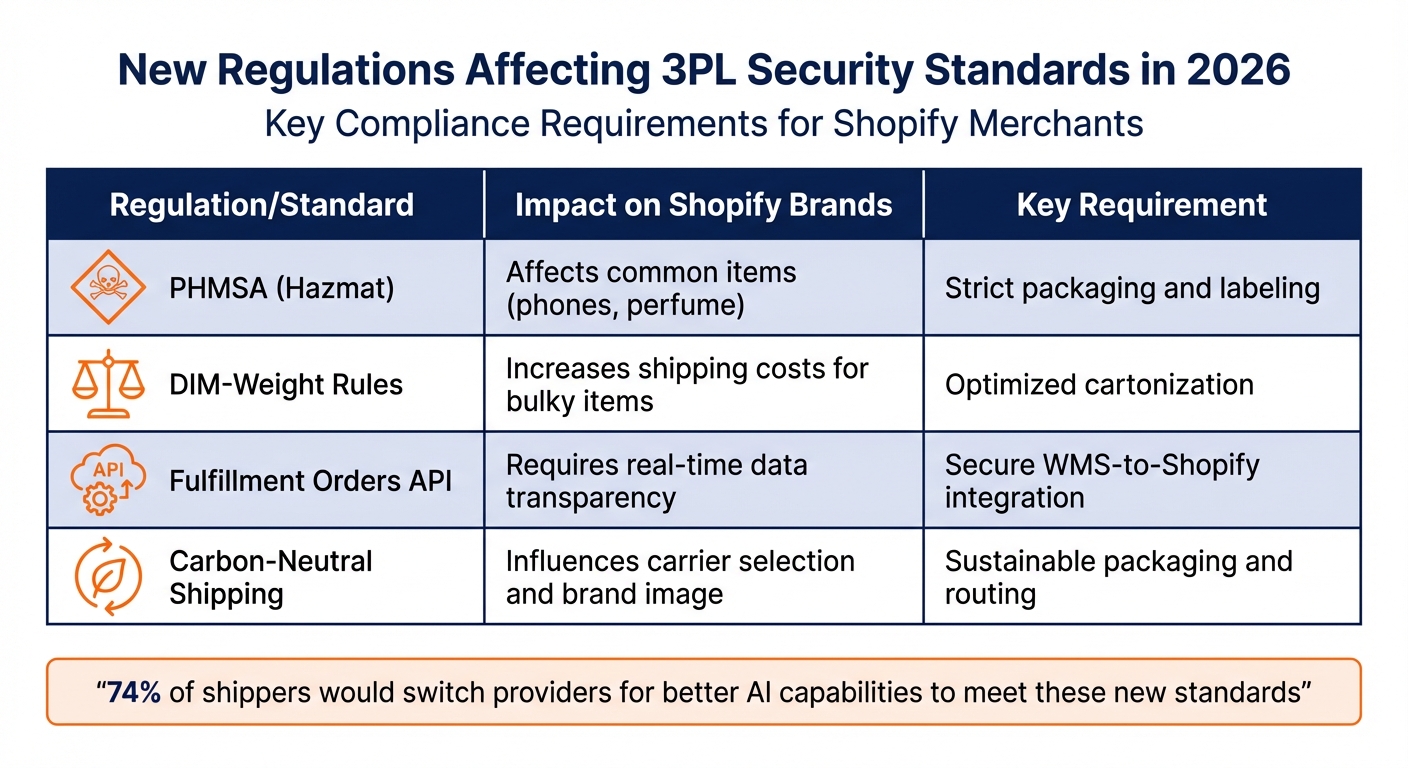
New Regulations Affecting 3PL Security Standards in 2026
By 2026, the landscape for 3PL operations has shifted dramatically, bringing with it new risks for Shopify merchants. Three key changes stand out: the rise of AI-driven cyber attacks, physical security challenges due to rapid warehouse expansion, and stricter regulatory requirements. These developments have led to mounting financial and operational losses.
Shopify's explosive growth - marked by a 31% year-over-year GMV increase to $124 billion in late 2025 - pushed 3PLs to scale operations at a breakneck pace. While this expansion supported demand, it also exposed vulnerabilities that smaller, slower-growing operations might have avoided. Let’s dive into how these changes are impacting fulfillment processes.
AI-Powered Cyber Attacks
Ransomware attacks have become a major disruptor for Shopify merchants in 2026, halting physical operations entirely. Trucks sit idle, picking systems grind to a halt, and canceled orders quickly tarnish brand reputations. A single breach at a 3PL partner can bring fulfillment to a standstill for days - or even weeks.
Hackers have zeroed in on integration points between Shopify stores and platforms like NetSuite or ShipStation. These API connections, often left vulnerable by outdated protocols or poorly managed access credentials, are prime targets. Additionally, warehouse staff have become frequent victims of advanced phishing schemes and malware attacks.
Legacy equipment compounds the issue. Outdated handheld scanners, unsupported routers, and obsolete Warehouse Management Systems create weak spots, especially during rapid facility expansion. But cyber threats aren’t the only concern - physical security is also under pressure.
Physical Security Gaps from Rapid Expansion
The rush to meet shipping deadlines during rapid growth has led to shortcuts that weaken security protocols. This has opened the door to increased theft, both from internal staff and external sources. Shoplifting incidents, which had already risen 18% in 2024, have surged even more by 2026 as warehouses struggle to maintain proper oversight.
Facility layouts have also become a problem. Overcrowded aisles and misplaced pallets block emergency exits and obstruct surveillance cameras, making it easier for unauthorized individuals to slip through unnoticed. High-density storage of fast-moving SKUs only adds to the challenge, creating chaotic environments where security lapses are harder to detect.
Rapid hiring to support expansion has introduced another layer of risk. Many new hires operate heavy machinery without adequate training or certification. OSHA reported over 2,500 workplace safety violations in warehouses between 2018 and 2023, and those numbers have climbed as speed takes precedence over proper onboarding. Compounding the issue, critical machinery often receives quick, makeshift fixes to avoid downtime, further jeopardizing safety and security.
New Regulations Affecting Security Standards
Adding to these challenges are stricter regulatory demands, which penalize non-compliance and disrupt fulfillment operations. Key regulatory changes in 2026 include:
- PHMSA (Hazmat) Enforcement: New packaging and labeling rules now apply to items like phones, perfume, and nail polish. 3PLs unprepared for these changes face shipment refusals and legal penalties.
- Shopify Fulfillment Orders API Update: Shopify’s updated API requires deeper integration with Warehouse Management Systems (WMS) to ensure real-time syncing and data accuracy. 3PLs that delay these upgrades risk losing inventory visibility and order tracking capabilities.
- DIM-Weight and Carbon-Neutral Shipping: Compliance with operational standards like optimized cartonization and sustainable practices has become essential. With 74% of shippers stating they’d switch providers for better AI capabilities, the pressure is on.
"Front-end AI growth creates back-end logistics pressure. If AI drives more demand... fulfillment operations must keep up - or brands risk delivery delays, rising costs, and customer churn".
| Regulation/Standard | Impact on Shopify Brands | Key Requirement |
|---|---|---|
| PHMSA (Hazmat) | Affects common items (phones, perfume) | Strict packaging and labeling |
| DIM-Weight Rules | Increases shipping costs for bulky items | Optimized cartonization |
| Fulfillment Orders API | Requires real-time data transparency | Secure WMS-to-Shopify integration |
| Carbon-Neutral Shipping | Influences carrier selection and brand image | Sustainable packaging and routing |
These changes underscore the growing complexity of 3PL operations and the heightened stakes for Shopify merchants navigating this evolving landscape.
Why 3PL Facility Security Matters for Shopify Merchants

When a 3PL’s security breaks down, it’s Shopify merchants - not the warehouse - who bear the brunt of the fallout. Merchants are the face of the customer relationship, while 3PLs handle the logistics. This disconnect means any security lapse at the warehouse directly impacts merchants, leading to lost revenue, broken trust, and unhappy customers.
Financial Costs of Security Breaches
Security failures at a 3PL can hit merchants hard financially. Theft during a breach means inventory disappears before it even reaches buyers, creating an immediate loss. On top of that, data breaches can expose sensitive customer information, setting merchants up for legal troubles and potential fines under privacy laws.
Switching to a new 3PL provider after a security failure isn’t a simple fix either. The transition can be expensive and time-consuming. Merchants often need to rebuild integrations with Warehouse Management Systems (WMS), Order Management Systems (OMS), and ERP platforms. This process can cost thousands of dollars and lead to weeks of downtime. And in cities like Los Angeles, where warehouse space can cost up to $21 per square foot, these expenses add up fast. While partnering with a 3PL can reduce logistics costs by 20–35%, a single breach can wipe out those savings overnight through lost products, operational delays, and customer refunds.
These financial setbacks also lead to operational slowdowns, which can quickly frustrate customers.
Order Fulfillment Delays and SLA Violations
The disruption from a security breach doesn’t stop at financial loss - it throws operations into chaos. Cyberattacks can knock out warehouse systems, while theft often forces time-consuming inventory audits, bringing shipments to a standstill. Orders get delayed, and customers are left waiting.
Today, nearly 50% of shoppers expect their orders to arrive in under two days. When a breach causes delays, merchants often face SLA violations. Without robust tracking systems, it’s hard to pinpoint whether the delay is due to security issues, shipping problems, or internal errors.
"We knew our 3PL wasn't meeting SLAs but had no way to hold them accountable... Now every missed deadline gets flagged." - vybey AU
These delays can create massive backlogs, sometimes taking weeks to clear. During this time, merchants may have to pause sales, deal with unhappy customers, and risk losing market share - especially during high-traffic events like flash sales or viral promotions.
| Cost Category | Impact of Security/Operational Failure |
|---|---|
| Inventory | Loss through theft or damage during a breach |
| Customer Lifetime Value | High; delays lead to customer churn as 50% expect fast delivery |
| Switching Costs | Expensive; rebuilding WMS/OMS/ERP integrations is time-intensive |
| SLA Penalties | Immediate; flagged violations result in reimbursement costs |
| Overhead | Higher; manual efforts needed to fix backlogs or data issues |
These disruptions don’t just cost money - they also damage customer relationships, as explained below.
Loss of Customer Trust
The biggest blow from a security failure isn’t just financial - it’s the loss of customer confidence. When shipments are delayed because of a breach, customers don’t blame the warehouse. They blame your store. And for many shoppers, one late delivery is all it takes to decide not to order again.
"Just one later-than-expected delivery and you risk losing customers." - Shopify
This is especially concerning as customer expectations continue to rise. In fact, 74% of shippers say they’d switch to a 3PL with better AI tools to meet these demands. Customers don’t want excuses - they don’t care if a cyberattack or theft caused the delay. All they know is their package didn’t arrive on time.
Data breaches add another layer of damage. If customer information is exposed due to a 3PL’s weak cybersecurity, merchants face public backlash. Complaints, bad reviews, and breach notifications all point back to the Shopify store, not the warehouse.
Some merchants, like Manly Bands, have found ways to reduce this risk. COO Eric Farlow explained how their team diversified fulfillment across multiple 3PLs. This strategy helped them maintain shipping commitments even when one provider experienced issues.
"By doing this, we have found that we have more control over our shipping commitments." - Eric Farlow, COO, Manly Bands
The takeaway is clear: merchants entrust part of their brand reputation to a third party. Without real-time monitoring and tools to hold 3PLs accountable, security failures can go unnoticed until it’s too late - leaving merchants to clean up the mess with frustrated customers.
How to Improve 3PL Facility Security
Security lapses often stem from weak procedures, outdated tools, or unnoticed vulnerabilities. For Shopify merchants, assuming their 3PL has everything under control can lead to costly mistakes. Instead, merchants should actively enforce security standards and regularly audit their 3PL's compliance.
The good news? Many improvements rely more on clear processes and accountability than on expensive upgrades. Here's how merchants can tighten security and prevent breaches.
Strengthening Physical Security
Physical security begins with controlling access. Merchants should ensure their 3PL uses badge-based entry systems for employees and enforces a visitor check-in process with ID verification and distinct badges for visitors. Loading docks should remain off-limits outside of shipping hours to deter unauthorized access.
High-value inventory requires restricted zones - think locked rooms or caged areas with user-specific access logs. Surveillance cameras should monitor all entry points, packing areas, and high-value zones, with footage stored for a set period and easily retrievable when needed.
"Security that is never looked at tends to fail quietly." - G10 Fulfillment
During site visits, merchants can use a "Three-Pass" Audit approach: identify non-negotiable security measures, verify physical controls, and request written documentation on logging practices to resolve potential 3PL conflicts before they escalate. Rather than accepting vague assurances, ask for concrete examples, such as how a recent inventory discrepancy was resolved, to confirm the 3PL's adherence to its protocols.
| Security Category | Specific Measure to Require | Verification Method |
|---|---|---|
| Perimeter | Fencing and proper lighting | On-site inspection |
| Access | Badge-only entry and visitor escorts | Review access logs and sign-in records |
| Surveillance | Continuous monitoring of critical areas | Request live and historical footage |
| Personnel | Immediate removal of access after termination | Cross-check termination logs with system access records |
| Inventory | User-specific audit trails | Request a "chain of custody" report for a specific SKU |
While physical measures are critical, they must work hand-in-hand with strong digital security practices.
Implementing Stronger Cybersecurity Protocols
Physical security alone isn't enough - cybersecurity is equally vital to protect sensitive data and systems. In 3PL operations, cybersecurity isn't just an IT issue; it's a core part of ensuring smooth logistics. Merchants should confirm their 3PL uses tokenized authentication and API gateway monitoring for platforms like Shopify to prevent unauthorized access. Multi-factor authentication (MFA) and role-based access control (RBAC) should also be mandatory for anyone handling sensitive data.
"A single unsecured endpoint or neglected integration point can be enough to breach the system and compromise operations or sensitive consumer data." - Phase V
To combat ransomware, 3PLs should maintain off-site backups, use immutable storage, and have incident response plans tailored for logistics. Merchants should ask if their 3PL conducts quarterly drills for ransomware or data breach scenarios. Outdated hardware, such as unsupported operating systems or handheld scanners, should also be flagged, as they are prime targets for hackers.
Many 3PLs now use cloud-based Warehouse Management Systems (WMS) with automatic updates, reducing vulnerabilities tied to legacy software. Merchants should request SOC 2 compliance documentation and ensure the 3PL performs annual risk assessments for their third-party vendors, minimizing risks from dependency chains.
| Security Layer | Recommended Protocol | Purpose |
|---|---|---|
| Data Exchange | Tokenized Authentication & API Gateways | Secures Shopify/ERP integration points |
| System Access | Multi-Factor Authentication (MFA) | Blocks unauthorized logins |
| Data Recovery | Immutable Storage & Off-site Backups | Protects against ransomware attacks |
| Hardware | Cloud-based WMS & Automatic Updates | Closes gaps in outdated systems |
| Personnel | Phishing Simulations & RBAC | Reduces risks from social engineering |
Operational Best Practices
Beyond physical and digital security, consistent operational practices are key to maintaining strong defenses. Security isn't a one-time setup - it requires ongoing vigilance. Regular audits, real-time monitoring, and accountability are critical.
Merchants should inspect warehouses for "process drift", where adherence to Standard Operating Procedures (SOPs) gradually weakens, creating vulnerabilities. Spot checks are also important: manually count 10 high-volume SKUs and five problematic ones, then compare these counts to the Inventory Management System (IMS). Weight-based verification on conveyor belts can help catch discrepancies, ensuring packages match expected weights.
To measure improvements, merchants can use a 0–2 scoring system during audits (0 = Poor, 1 = Acceptable, 2 = Excellent). Automated SLA monitoring tools, such as Forthmatch, can flag security issues early by tracking fulfillment speed and identifying SLA violations in real time. Merchants should set up instant alerts to notify their 3PL of any delays or breaches.
Finally, holding Accountability Sessions allows merchants to track 3PL performance over a few weeks, creating a documented record of progress - or lack thereof. This data can be invaluable during contract negotiations, showing whether the 3PL is meeting expectations or falling short.
How Forthmatch Helps Shopify Merchants Monitor 3PL Security
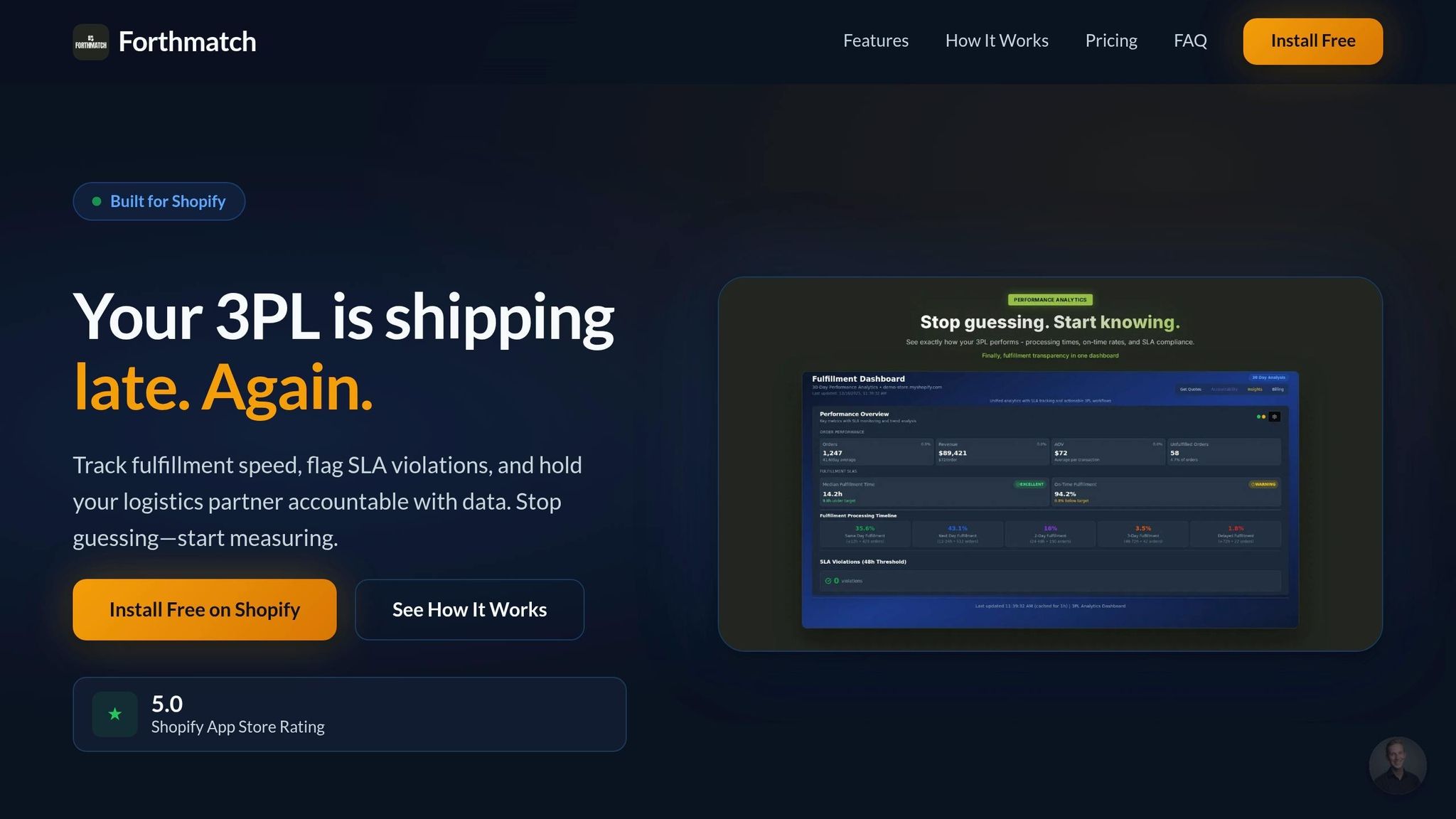
Forthmatch provides Shopify merchants with a way to tackle the tough challenges of monitoring and improving 3PL facility security. When security lapses occur, they often show up as unexplained delays, missed SLAs, or stalled orders. For merchants, the real challenge is figuring out whether these issues stem from carrier problems or deeper, facility-level failures. That’s where Forthmatch steps in, offering real-time tracking and identifying operational red flags that could signal security or compliance problems.
Automated Performance Tracking and Alerts
Forthmatch keeps an eye on every order from start to finish. It flags orders that exceed your SLA thresholds, whether it’s a widespread slowdown or an isolated issue that might hint at a system outage or security breach. Merchants can set both median and maximum processing times to catch these problems early.
When a violation happens, the platform sends a one-click email alert to your 3PL provider, creating an instant record. This built-in accountability system also tracks how your 3PL responds and what solutions they propose, ensuring their promises turn into actionable commitments.
"We knew our 3PL wasn't meeting SLAs but had no way to hold them accountable. Forthmatch's alert system changed that... Our provider went from ignoring issues to actually responding with action plans." - vybey AU, Braincare Nutrition
Pinpointing Root Causes of Security Failures
Forthmatch’s root cause analytics take things a step further by analyzing delays and separating carrier-related issues from internal 3PL facility problems. This is crucial because repeated facility-level disruptions - especially during off-peak hours or across multiple SKUs - could point to deeper security or compliance concerns.
The platform even reviews up to 90 days of historical Shopify order data when you first install it, creating a baseline for performance. This helps merchants figure out whether current problems are new or part of a long-standing pattern. Armed with this data, you can go into quarterly business reviews or contract negotiations with clear, objective insights.
Tools for Managing 3PL Partnerships
Forthmatch doesn’t stop at identifying problems - it equips merchants with tools to hold their 3PL providers accountable.
- Accountability Sessions ($89 one-time): These sessions establish a 30-day performance baseline to ensure operational fixes and security upgrades are implemented. You’ll also get a before-and-after report to use during contract discussions or when requesting SLA credits.
- RFP Quote Request Tool ($44 one-time): If your 3PL consistently falls short, this tool uses your order data to create an automated Request for Proposal. It matches you with pre-vetted regional providers, making it easier to switch to a more reliable partner. With 74% of shippers open to changing 3PL providers for better performance, having solid data makes the transition smoother and more defensible.
| Feature | Security Monitoring Function | Merchant Benefit |
|---|---|---|
| SLA Monitoring | Flags orders exceeding processing thresholds | Early detection of facility-wide disruptions |
| Root Cause Analytics | Categorizes delays by source | Separates carrier issues from 3PL failures |
| Accountability Sessions | Tracks 30-day improvement trends | Holds 3PLs accountable for security recovery |
| RFP Generation | Matches data with alternative providers | Simplifies transition to better partners |
With Forthmatch’s real-time analytics and accountability tools, improving your 3PL security becomes manageable. Ready to take control? Start using Forthmatch for free and see how real-time monitoring combined with data-driven accountability can make a difference. Visit Forthmatch - Free today.
Conclusion
In 2026, securing a 3PL facility that matches your needs goes beyond just preventing theft - it’s about shielding your entire operation from new and evolving threats. For Shopify merchants, lapses in security can result in financial losses, missed SLAs, and eroded customer trust.
The risks are real and backed by industry statistics. In 2023, the transportation and warehousing sector reported 930 fatalities, and by 2024, shoplifting incidents among retailers had jumped 18% compared to the previous year.
"Any major hiccups impact your brand's reliability - something online shoppers won't compromise on. You can't afford not to take proactive steps to minimize failures in the warehouse." - Elise Dopson, Shopify
By moving away from guesswork and embracing data-driven accountability, these challenges can become opportunities. Tools like Forthmatch help make this shift possible. With real-time visibility and automated alerts, Forthmatch separates facility-level security delays from carrier issues, providing actionable insights to improve performance.
Don’t leave your customer trust to chance. Start using Forthmatch for free today and gain the tools you need to protect your operations and deliver the reliability your customers expect.
FAQs
What is 3pl facility security?
3PL facility security refers to the systems and practices third-party logistics providers use to protect inventory, ensure safety, and minimize risks like theft or damage within their warehouses and operations. These safeguards play a key role in maintaining efficient logistics processes and securing valuable goods as they move through the supply chain.
Why does 3PL facility security matter for Shopify merchants?
For Shopify merchants, keeping inventory secure is not just a logistical concern - it’s a cornerstone of maintaining customer trust and smooth operations. When security lapses occur, whether through theft or breaches, the consequences can be severe. Lost inventory, shipping delays, and even compromised customer data can tarnish a brand’s reputation and erode customer satisfaction.
To avoid these risks, implementing strong security measures is essential. Practices like regular audits and stringent safety protocols can help protect your fulfillment operations. In the fast-paced world of e-commerce, staying vigilant about security ensures your business remains competitive while keeping your customers happy.
How does Forthmatch help with 3pl facility security?
Forthmatch strengthens security at third-party logistics (3PL) facilities by offering real-time tracking and accountability tools. Shopify merchants can keep a close eye on their logistics partners, flag any service-level agreement (SLA) violations, and dig into delays to uncover potential issues.
These tools make it easier to spot risks like inventory mismanagement or even data breaches early on. By delivering transparent performance reviews and tracking how accurately orders are fulfilled, merchants can ensure their partners meet necessary security standards. This approach helps minimize threats like theft or cyberattacks, providing an extra layer of protection for the supply chain.